


In Part One, we discussed the global crude oil shipping industry and how Mohnish Pabrai found it in 2001 and rediscovered it and Frontline in 2002, as the company’s stock price fell sharply. Now, we’ll turn to some more details around the company: what was particularly risky and particularly intriguing about it.
Frontline: A particularly risky shipping investment
Mohnish Pabrai was naturally intrigued by the steep decline in Frontline’s share price that had occurred from May through September of 2002.
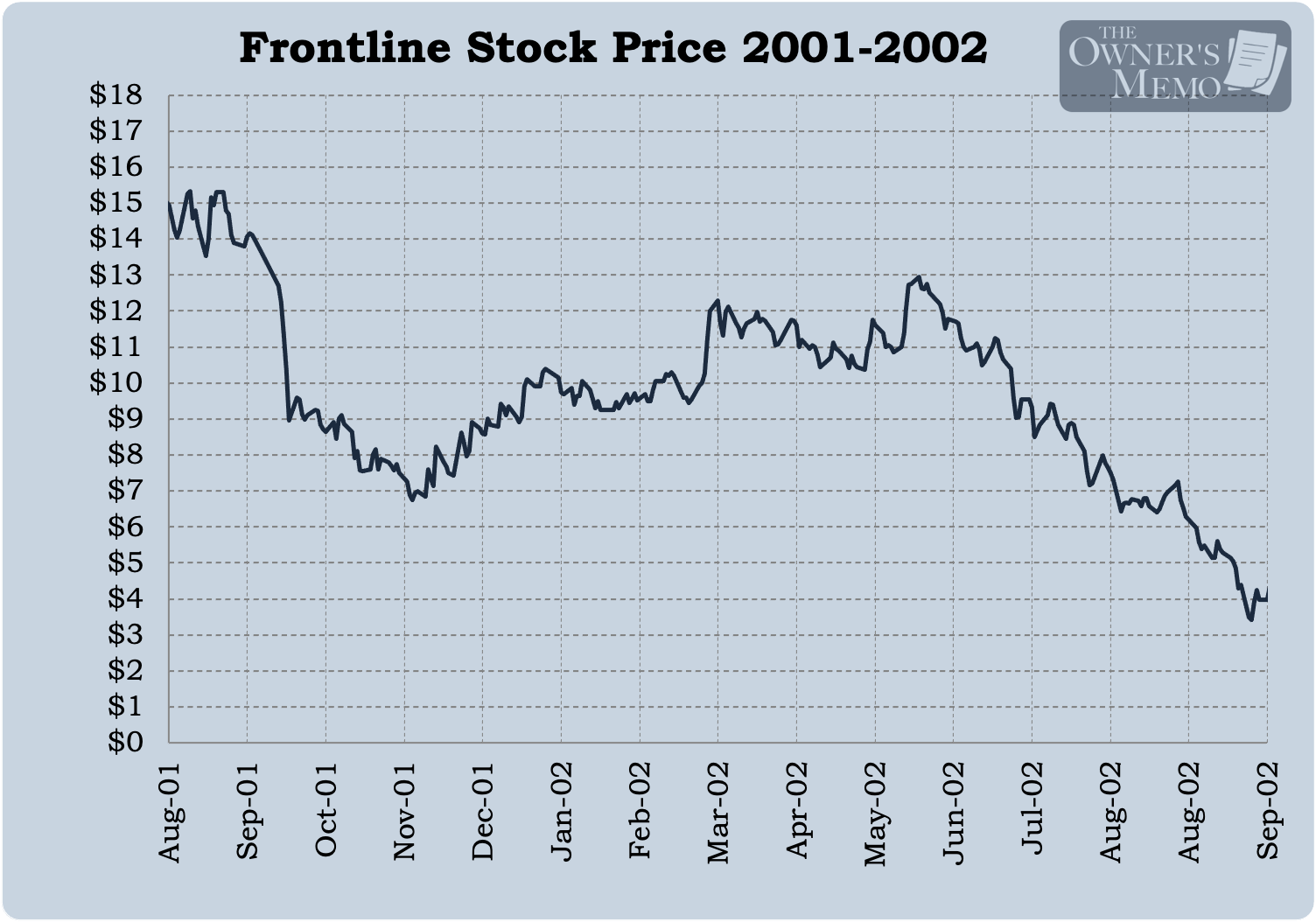
But an investment in Frontline wouldn’t have been without risks that he must have considered. In Part One, we briefly discussed one of them: TCE charter rates in 2002 had fallen to a level below Frontline’s expense base. What if they remained there indefinitely? There were other risks in the company as well. Let’s discuss those and try to determine how Pabrai got comfortable with each.
Risk #1: Frontline bet heavily on the spot charter market
In deciding how to utilize their ships, many shipping companies will opt to diversify their chartering business among long- and short-term chartering, that is, between the three types of chartering we discussed before: bareboat chartering for very long charters and the most highly assured revenue stream, time chartering for chartering revenue over the medium-term, and voyage (spot) chartering, whereby rates change every day and are set with every trip.
Spot chartering is the riskiest of the three in that a company will be unprotected when a downturn in the charter cycle arrives. Of course, spot chartering also allows a company to capture the upside when the cycle turns up as well.1
Time charters are for weaklings.
- Coco Jacobsen, a character in The Shipping Man by Matthew McCleery, at least partially based on Frontline CEO John Fredriksen
Frontline was a company that was unabashed in its desire to play the spot market. Of the company’s 69 owned vessels in 2002, 48 (70%) were being chartered on the spot market. Teekay, one of Frontline’s competitors, on the other hand, reported 57% of its revenues from spot chartering in 2001. OMI Corporation reported 50% of its vessels operated on the spot market. Stolt-Nielsen reported 46% of its tanker business was done under spot contract.
This exposure to the spot market hurt Frontline in 2002. In the second quarter, the company reported that TCE rates were between $15,300 and $17,600, still hovering below the $17,400 breakeven cost we referenced earlier. Frontline also reported a net loss of -$16.9 million for the first half. Compare that figure to the five of Frontline’s competitors.
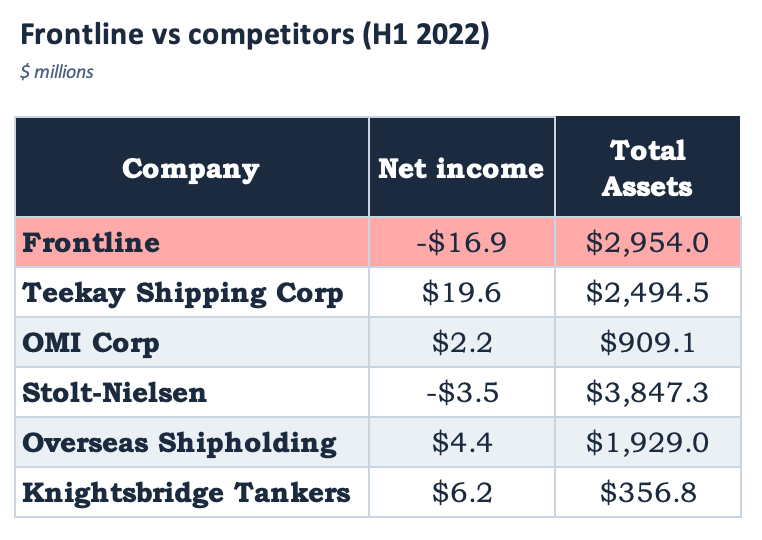
No other competitor in the group (except one) had produced a net loss in the first half of 2002, but Frontline had, which was a consequence of its bet on spot market chartering and the down cycle in charter rates.
Frontline’s appetite for risk was hurting the company in the downturn in 2002, and that was reflected in the stock price. Frontline’s stock was down 73% over the four months from May to September 2002. During that same timeframe, for example, OMI and Stolt-Nielsen saw their stock prices fall by only 42% and 37%. The market was punishing Frontline for its risk appetite.
Moreover, Frontline’s risk-loving nature seemed directly attributable to the man at the helm. John Fredriksen was the CEO of Frontline, and he had a reputation for being a swashbuckling risk taker.
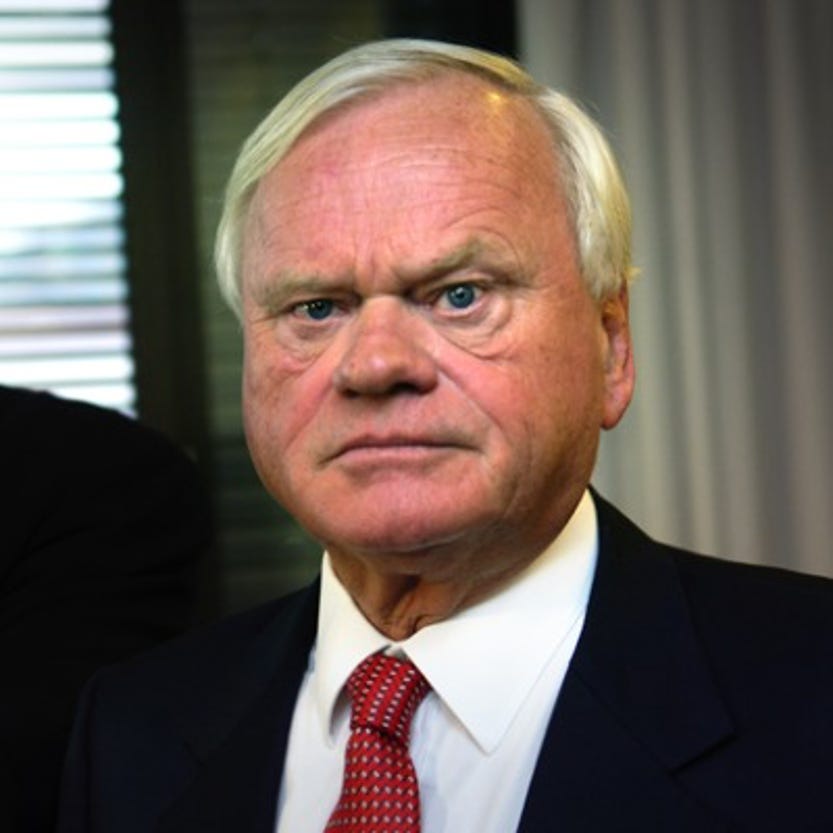
From a Bloomberg profile of Fredriksen in 1997:2
“He’s a bit of a cowboy,’‘ said Cato Hellstenius, an analyst at Handelsbanken Markets. He has a completely different style than the other shipowners, and takes extremely high risks.
By 2002, Fredriksen was already a legend in the industry and had apparently amassed a sizable fortune.
His assets now include a stake in Vaalerenga ASA, the local football club, as well as ships, real estate and art worth about 4.2 billion kroner ($577 million), according to Kapital.
Reading about Fredriksen, I was genuinely torn. While his adventurous style, evident in the way Frontline was run, did have something to do with the market’s negative perception of Frontline in the fall of 2002, it’s also quite possible that in the tough and unpredictable industry of shipping, Fredriksen’s nature is what led Frontline to become the success it had been.3
Also, there was one very important point that might assuage an investor who was wondering about Fredriksen: the man was aligned with shareholders. Per the company’s 2001 20-F report, Fredriksen owned 34,579,054 shares of Frontline’s stock, a stake of 45.2%.
Risk #2: Frontline’s web of transactions and the Golden Ocean bankruptcy
Frontline Ltd., the company Pabrai was considering in 2002, was built by Fredriksen in a series of mergers and purchase transactions of other companies. Fredriksen had been acquiring shares in Frontline AB through his vehicle called Hemen Holding Ltd. and AB was acquiring other small companies, growing its fleet size. On September 22, 1997, AB announced a merger with London & Overseas Freighters Limited (LOF), and Frontline Ltd. was born.
From 1996 to the fall of 2002, Frontline engaged in many acquisitions or mergers with the stated goal of increasing its fleet and gaining scale in the industry. By 2002, it had the largest fleet of VLCC and Suezmax tankers in the market.
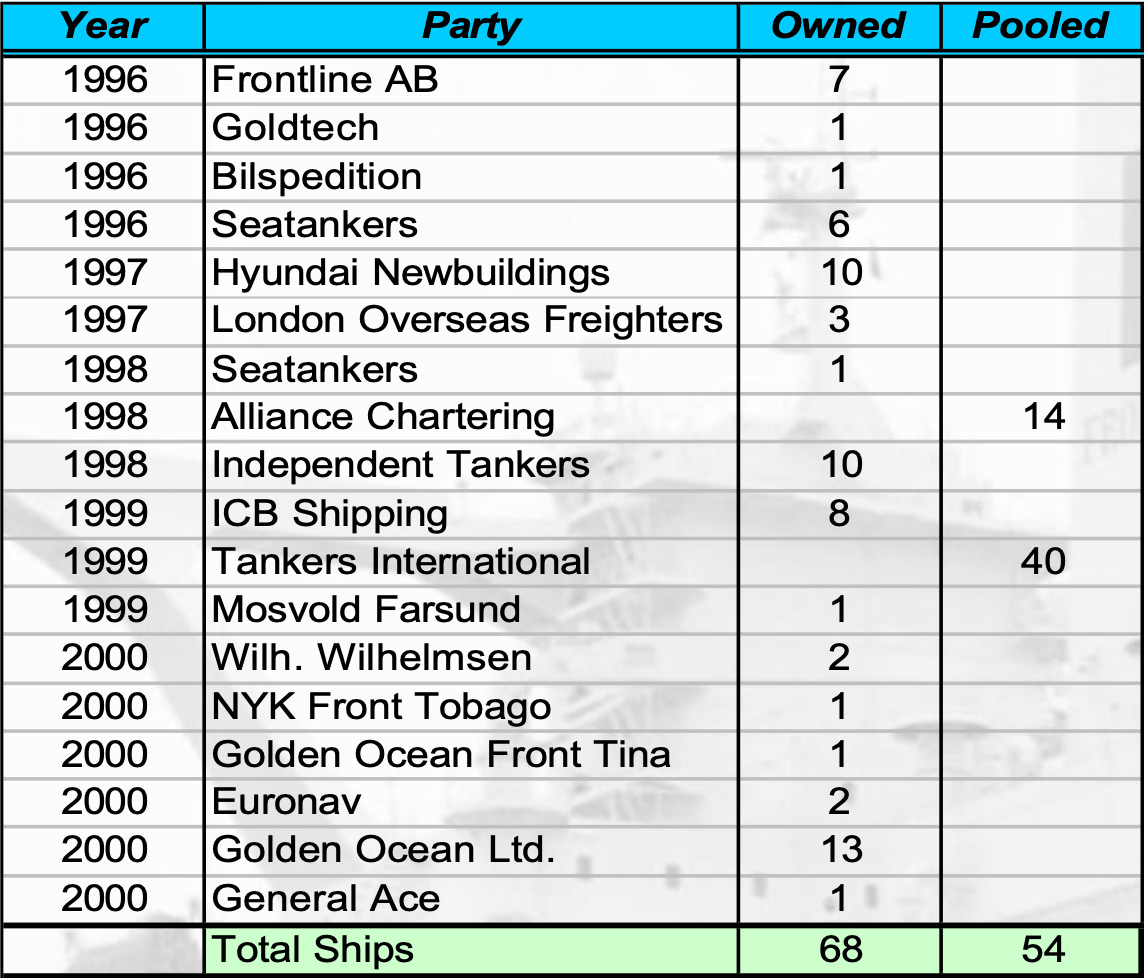
For a shipping industry outsider, this might look like hyperactivity, but for a shipping man, this was not all that strange. The shipping industry was a highly fragmented industry in 2002 (and still is today, albeit less so), and acquisitions were common as companies looked to consolidate and gain scale as an advantage.
We believe that fleet size in the industrial shipping sector is important in negotiating terms with major clients and charterers. We believe that a large, high-quality VLCC and Suezmax fleet will enhance our ability to obtain competitive terms from suppliers and shipbuilders and to produce cost savings in chartering and operations.
- Frontline 2001 20-F annual report
Moreover, the corporate structure of shipping companies differed from that of companies in other industries. For every ship (or a few ships) that a shipping company owns, it creates a separate subsidiary company. The main reason for this is to ring-fence liability as much as possible. If a ship was involved in an oil spill, for example, having the ship be owned by a separate company limits legal risk as much as possible. In addition, some jurisdictions operated under a “sister ship” theory of liability in which a claimant against the company may arrest both the vessel which is subject to the claimant’s lien and any “associated” vessel controlled by the same owner. Separating vessels helps to limit this risk too. Finally, should the company need or desire to sell the ship (as was common), the sale could be effectuated easily by selling the stock in the individual shipco.
Indeed, most of what look like corporate acquisitions in the table above are simply the effective purchase of one or more ships by Frontline.
However, there was one transaction that could have raised an eyebrow: Golden Ocean Ltd.
Golden Ocean (GO) was a company that owned or owned interests in 14 VLCCs and 10 dry bulk carrying ships. The company embarked on an aggressive newbuilding program in the late 1990’s near a cyclical peak for the industry. It took delivery of those ships (and needed to service the mortgage debt that came with them) just as the tanker market started to weaken in 1999. The company ended up filing for bankruptcy protection in January of 2000.
Frontline’s 2001 20-F tells some of the story:
Golden Stream Corporation was party to a loan agreement with Griffin Shipping Inc. (”Griffin”). The amount outstanding under this loan agreement was $48,068,000, which was fully repayable on March 30, 2002. Repayment of the loan is secured by a first mortgage on the vessel Golden Stream... Golden Stream Corporation failed to repay the loan on the due date.
The story seems concerning on its surface, but a more detailed read of the 20-F reveals that Frontline actually swooped in as a distressed buyer of GO after it declared bankruptcy and hence a kind of solutions provider for the company’s lenders.
In 2000, the Company sponsored a plan of reorganisation, or the Plan, for Golden Ocean in the United States Bankruptcy Court for the District of Delaware. The Plan became effective on October 10, 2000, at which time the Company acquired Golden Ocean. As part of the Plan, the Company paid an aggregate amount of approximately $63 million and issued an aggregate of 1,245,998 Ordinary Shares to holders of allowed claims against Golden Ocean.
So, Frontline’s agreement to purchase GO in October 2000 was both beneficial to GO’s creditors (allowing them to receive from Frontline what they felt was the maximum recovery on their loan to GO) and it allowed Frontline to acquire, either directly or through options, up to the 24 vessels that GO owned. The cost of this transaction to Frontline was $63mn.
A further read of the 20-F reveals that Frontline appears to have taken on zero or minimal liability with respect to the GO bankruptcy.
The acquisition of Golden Ocean was conducted so that the loans held by Golden Ocean’s subsidiaries are non-recourse to Frontline. This implies that any guarantees on behalf of a Golden Ocean subsidiary are issued only by either Golden Ocean and or other Golden Ocean subsidiaries. Frontline’s exposure to Golden Ocean is therefore limited… At June 30, 2002, Frontline’s exposure in the event of a liquidation of Golden Ocean is a maximum of $15 million in equity.
In the end, what seemed to the casual reader or investor like an overactive management team acquiring company after company, one of which was in bankruptcy, seemed, upon closer inspection, to be much less risky.
Frontline was executing a consolidation of a fragmented industry (and focusing on the sub-industry of VLCC and Suezmax tankers), and it was looking for opportunities to acquire those assets in distressed situations, while limiting its own risk.
Risk #3: A potential extended downturn in charter rates
Perhaps the most severe risk of all to Frontline was the potential for charter rates to enter a prolonged downturn. Should that have been the case, Frontline, by virtue of its bet on the spot rate market, would have had to deal with losses for an extended period.
The downturn of the 1970’s and 1980’s
In fact, such a downturn would not have been unprecedented. Stopford describes the brutal and prolonged downturn of the mid 1970’s to 1980’s.4
Between 1962 and 1974 the demand for seaborne oil transport, measured in ton miles, almost quadrupled… in the early 1970s tankers were in such short supply that ships were sold ‘off the stocks’ for twice their original contract price – in the peak freight market of 1973 the profits on a few voyages were sufficient to pay off the invest-ment in the ship. This led to record orders for new ships.
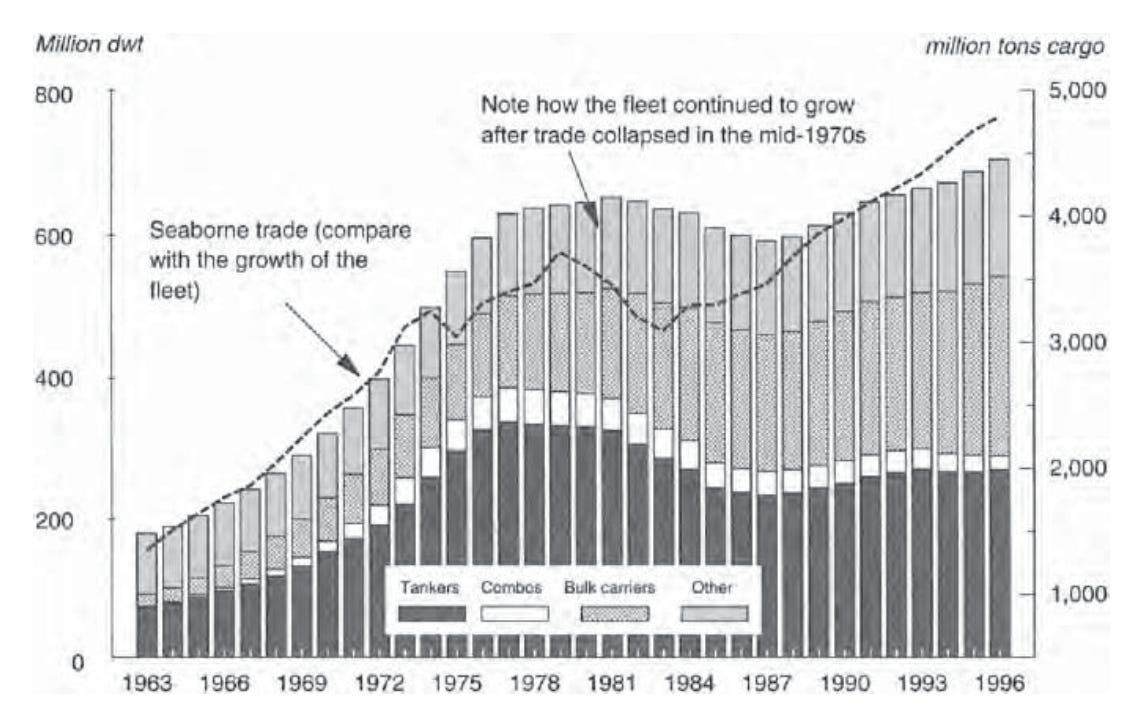
In the mid-1970s the whole process was thrown into reverse. Over the next decade tanker demand fell by 60% and the tanker market was confronted with the problem of bringing supply and demand into balance. It took about 10 years for supply to adjust to such a major change in demand… After the collapse of the trade in 1975, the fleet continued to grow as the orders placed in 1973 were delivered, reaching a peak of 336 million dwt in 1977. Scrapping did not start until the owners of the vessels became convinced that there was no future for them. This position was reached in the early 1980s when the second-hand price of VLCCs, some of which had cost $50–60 million to build in the mid-1970s, fell to $3 million. There was so little demand that sometimes ships put to auction did not attract a bid. The only buyers were shipbreakers. As scrap sales increased the fleet started to decline, reaching a trough in 1985. When the oil trade recovered in the late 1980s, supply and demand grew closer together, and freight rates increased. The whole cycle took about 14 years and by 2007 the tanker fleet was still only 354 million dwt.
Well, that’s frightening isn’t it?
The deep cycle of the 1970’s saw tanker prices go from as high as $60 million for newbuildings to as low as $3 million in the secondary market. If the market after 2002 experienced a continued decline like that one, there would be almost nothing Frontline could do to survive.
But the downturn of the 1970’s was different from the decline Pabrai was working with in 2002. The 1960’s saw large increases in world trade, with seaborne trade growing from 990 million tons in 1959 to 3,233 million tons in 1973, according to Stopford. Along with this huge increase came a surge in shipbuilding capacity and in ships delivered.
However, the Yom Kippur War in 1973 and recession in 1975, followed by dramatic increases in the price of oil ended the good times for shippers. Here is Stopford again:
There were essentially three problems which contributed to the depth of this recession. The first was the oversupply of tankers resulting from the speculative investment in the early 1970s… surplus tanker capacity of 100 million dwt… Secondly, the world shipbuilding industry was now able to build 60 million dwt of merchant ships each year. This was far more than was required to meet the demand for new ships even if the trend of the 1960s had continued. Shipyard capacity was not easily reduced and it took a decade of over-production to cut capacity to a level more in line with demand. Thirdly, the oil price rises in 1973 and 1979 dramatically reduced the demand for oil imports.
The 2002 downturn
As difficult as it may have been for an investor to confront a potential shipping downturn like that of the 1970’s, there were reasons to believe the downturn in 2002 was not nearly as bad as that.
First, the increase in world seaborne trade over the 1990’s was much less than that of the 1960’s. Second, the number of ships in the world fleet had hardly increased much over 1980’s and 1990’s. The figure below from Stopford shows the difference between the two periods.5
Moreover, there were two positive trends that ship owners had going for them in the year 2002.
Positive trend #1: The rise of China
First, China was growing rapidly and had recently joined the World Trade Organization. The Chinese economy had averaged 10% GDP growth in the 1990’s and was becoming a bigger participant in world trade. The country joined the WTO on December 11, 2001, a move designed to pressure domestic reform, especially of a bloated state-owned enterprise system, to secure market access and trade stability, and to commit to export-led growth and integration into global supply chains.
Importantly, WTO membership also came along with a commitment by China to lower tariffs.6
Tariffs on industrial goods of greatest importance to U.S. businesses will be reduced from a base average of 25 percent (in 1997) to 7 percent…
China has agreed to participate in the Information Technology Agreement, which requires the elimination of tariffs on computers…
Tariffs on autos will be reduced from 80-100 percent to 25 percent
Oil importing, in particular, was pointed to in the International Energy Agency’s 2002 report:7
Oil import restrictions, which have long given these companies a near-monopoly in the downstream market, are being dismantled in the wake of China’s entry into the WTO. Until recently, the government has used a quota system to favour imports of crude oil over oil products, in order to maximise domestic refining capacity. Immediately on joining the WTO, the government began issuing crude oil import licences to private trading firms and committed itself to increasing their quotas by 15% per year. Those quotas will be abolished in 2006. Crude oil import tariffs were removed in 2002. Oil product import quotas and tariffs will be removed at the end of 2003.
Though these changes wouldn’t be carried out overnight, they signaled that China was ready to be a much larger trade partner with the world, which would have been a boon to shipping.
Positive trend #2: Increased scrapping due to regulation
This is a critical detail, and it is one that Pabrai cites in his reasoning for purchasing Frontline’s stock. It is also cited across Frontline’s annual report.
The oil tanker industry in 2002 was composed of two kinds of tankers: single-hull and double-hull. In 1989, the single-hulled VLCC Exxon Valdez grounded on Bligh Reef in Prince William Sound, Alaska, spilling about 11 million gallons of crude oil. The result was swift regulation from the US and later, from the International Maritime Organization and the EU.
Per Frontline’s 2001 20-F annual report, the effect of this regulation was to mandate the phasing out of single-hull tanker ships completely between 2005 and 2015. That same report shows that, of Frontline’s 64 owned oil tankers (59 vessels and 5 newbuildings on order), 44 of them were double-hull and 20 were single-hull (31%).
On its face, this might look concerning for Frontline, but when weighed against the rest of the market, it was actually an advantage. Frontline’s fleet was deliberately dominated by double hulls.
As we discussed before, Frontline was formed in a roll-up of the industry by John Fredriksen starting around 1996, well after the single-hull regulation was announced and put in place. Fredriksen’s strategy in building the company wasn’t just to buy up any ships; it was to (1) buy modern ships built after 1990 (when single-hulls stopped being built) and (2) to create scale advantages in the VLCC and Suezmax markets specifically.
The slide below, from a Frontline presentation in November 2001 states as much.
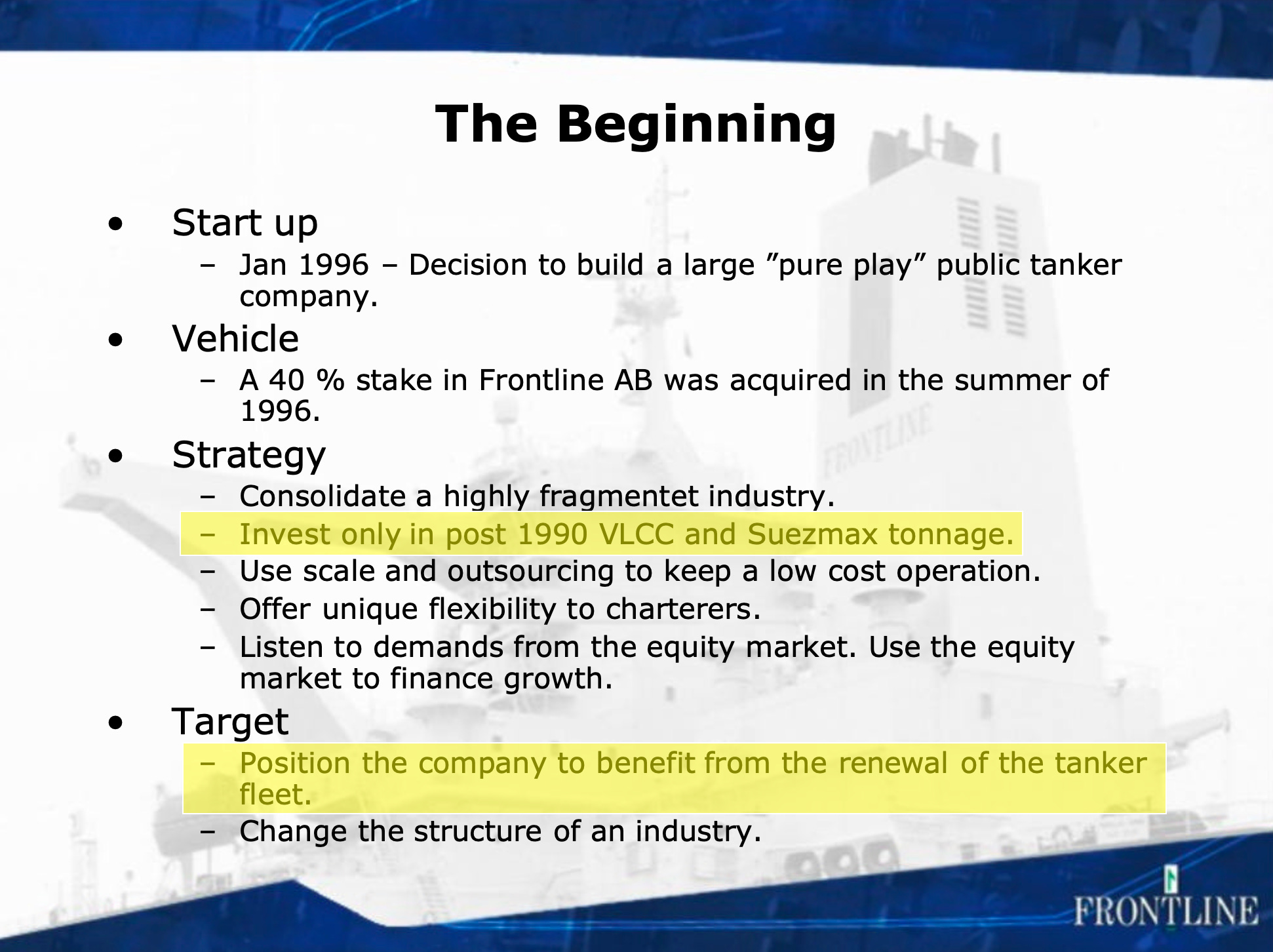
And a careful examination of industry data shows that Frontline was executing on its plan. According to industry research from Clarksons, in September of 2002, 66% of the tanker market was single-hull versus 31% for Frontline.8
What would this mean for Frontline?
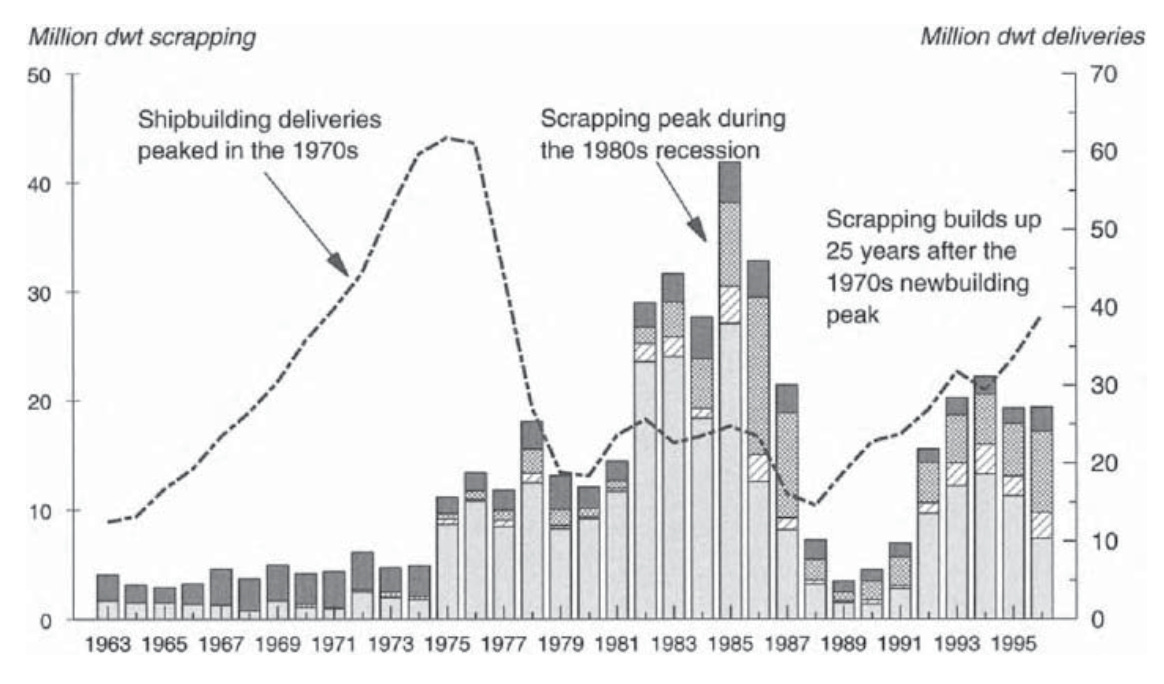
In a market downturn when charter rates were low, like the one the industry was going through in the first half of 2002, many companies would be forced to raise cash by either selling ships or scrapping ships. Single-hulled ships would be the first to be scrapped, as shipowners, worried that the ships would soon be out of service, could not currently be operated profitably, and were burning cash on maintenance, opted to scrap and receive a few million dollars of value rather than continue to pay for a money-losing ship.
In fact, that trend was already beginning. Stopford’s Maritime Economics shows scrapping rates below. After the high charter rates (and low scrapping rates) from 1988 to 1991, scrapping began to increase in the 1990’s, mainly composed of older single-hulled ships that would ultimately need to be removed from service.
Frontline, on the other hand, was purpose-built to have an advantage in a downturn.
By deliberately focusing on buying the newest double-hulled ships, which naturally had longer lives, its fleet would benefit as single-hulls were scrapped in the downturn and tanker supply was taken out of the world market.
In addition, by deliberately focusing on scale as the largest VLCC/Suezmax owner, it would be well-suited to survive any downturn because of lower operating costs and having more ships to potentially sell if it needed to raise cash.
That was Frontline’s strategy in a nutshell. Limit the downside in a cycle downturn by owning newer ships and a lot of them, while competitors with older ships and fewer of them felt the pressure of losses and the need to resort to more scrapping, which would limit the global supply of tankers and, in turn, limit any cycle downturns, allowing Frontline to remain standing and benefit in the upturn.
Now it becomes a little more clear why Frontline focused on spot chartering. Fredriksen wasn’t simply gambling. He had a reasonable strategy for making it through cycle downturns, which he expected to be shallow because world fleet capacity would remain low from the single-hull phase out. Spot chartering would allow him and Frontline shareholders to make the most money in the cycle upturn.9
In Part Three, we’ll get to the crux of the investment, how Pabrai dimensioned the risk to Frontline, when he made his investment, and how it fared.
References:
Stopford, Martin. (1997). Maritime Economics (2nd edition). Routledge.
Stopford, Martin. (2009). Maritime Economics (3rd edition). Taylor & Francis.
McCleery, Matt. (2012). The Shipping Man. Marine Money International.
The astute observer will note here that, since every shipping company is playing the same game, spot chartering could be a sound strategy and perhaps less risky. If most companies are using time or bareboat charters, an uptick in the cycle would result in a spot-chartering company outperforming those other companies, resulting in more earnings and more capital and enabling them to better compete for business by buying more ships or even making takeover attempts of other companies.
Frontline’s Fredriksen Builds Tanker Giant, Bloomberg, September 27, 1997
The Shipping Man by Matthew McCleery is a great fictional work about the tanker shipping industry. McCleery is the long-time President of shipping advisory firm Marine Money, and, while TSM is a work of fiction, one cannot help but understand when reading it that the shipping industry is made up of both sophisticated operating and financial professionals and wild gamblers and risk-takers. Reading the book helped me understand Fredriksen a bit more.
Maritime Economics, 3rd edition, Chapter 4.
Maritime Economics, 2nd edition, Chapter 4.
World Energy Outlook 2002. International Energy Agency. September 24, 2002.
Oil & Tanker Trades Outlook, September 2002. Clarkson Research Studies.
I will note here that competitors who relied on longer-dated time chartering or bareboat chartering should have been better able to weather a cycle downturn than Frontline. In fact, that is why Frontline’s stock was down so much relative to the industry in late 2002. Fredriksen was making a bet that the downturns would be limited, while keeping Frontline strong enough to survive them.
Coco 😭
Love that book