


There is no exoneration from pain, uncertainty, or the need for constant work.
- Phil Stutz, True and False Magic
In his book True and False Magic and in several other works, psychiatrist Phil Stutz makes the provocative statement that all people, no matter who they are, must deal with three constants in their lives: pain, uncertainty, and the need for constant work.1 Consider the last one for a moment.
Danny Meyer
Bill Gurley’s book Runnin’ Down a Dream profiles nine well-known people as they search for their callings. The book grew out of his equally great lecture, and both are inspirational. What many people take from them, and which seems undoubtedly true, is that, in order to be great at what you do, you must love it.
Here is Gurley describing Danny Meyer, the famous restaurateur, early in his career when he was working at Pesca in New York City:
Mostly, Danny just soaked up everything…
He had gone from making $125,000 a year to a weekly salary of $250, but Danny loved everything about life in the restaurant world. He was exhilarated by the fast-paced intensity. He relished the chance to do the things other people might find mundane or unpleasant, like tossing the seafood pasta or cutting the faces off the soft-shelled crabs…
He was learning what made certain restaurants stand out from the city’s crowded dining scene…
Danny had never studied this hard. But he had never loved a subject this much.
What would have been hard, unpleasant work for others was a joy for Danny Meyer.

That certainly sounds like love, but there is another force buried in each of Gurley’s nine stories: compulsion.
Here he is again, describing Meyer as he foundered early on, trying to decide what to do with his life. The night before he was set to take the LSAT, he complained to his uncle Richard that he didn’t even want to be a lawyer.
Danny told him he wasn’t sure what else he could do. His uncle was incredulous.
“Why don’t you just do what you’ve been thinking about doing your whole life?”
Danny looked confused. “What’s that?” he asked.
”Since you were a child, all you’ve ever talked about or thought about is food and restaurants,” Richard said. “Why don’t you just open a restaurant?”
On its surface, the story seems surprising: Danny Meyer didn’t realize he should have been in the restaurant business? But upon deeper thought, is it so shocking? All of us, to some degree, have things we do naturally, our compulsions, that we become a little blind to. Meyer’s compulsion for restaurants was so deep that he had trouble seeing it himself at that point.
Michael Burry
Michael Burry has been an investor I’ve admired for years. Burry made a name for himself creating a way to short subprime mortgage bonds in the years leading up to the 2008 financial crisis. I’ve always thought of him as an investor who would put in more work than 99% of his investing peers.
Burry got his start as a professional investor in an odd way. In the late 1990s, he completed medical school at Vanderbilt University and then began a residency in neurology at Stanford University Hospital, where he realized his heart wasn’t in the practice of medicine. Investing, on the other hand, was a different story. After working sixteen-hour shifts at the hospital, he would somehow find the energy and effort to study the craft, often after midnight. He particularly relished the diligent, scrupulous work of unearthing great investments, reading documents and piecing together information few others had. I like Burry’s start because it gives me a feel for the type of dedication it takes to be a superior investor.
What’s more, rather than simply reading passively, Burry was sharing his work on the internet message board Silicon Investor. In fact, his posts are still live on the website, and anyone can go back and study the work he did. Over the course of the 1,736 days he was active on the site, from 1996 through 2001, Burry posted 3,277 times, averaging almost two posts a day for nearly five years, much of it while working a more-than-full-time job.

Michael Lewis’s book The Big Short profiles Burry, and Lewis recounts several anecdotes throughout that describe how hard Burry worked. Here is his account of the work Burry did to understand the fine details of subprime mortgage-backed securities:
Every mortgage bond came with its own mind-numbingly tedious 130-page prospectus. If you read the fine print, you saw that each was its own little corporation. Burry spent the end of 2004 and early 2005 scanning hundreds and actually reading dozens of them, certain he was the only one apart from the lawyers who drafted them to do so... As he explained in an e-mail:
”So you take something like NovaStar, which was an originate and sell subprime mortgage lender, an archetype at the time. The names [of the bonds] would be NHEL 2004-1, NHEL 2004-2, NHEL 2004-3, NHEL 2005-1, etc. NHEL 2004-1 would for instance contain loans from the first few months of 2004 and the last few months of 2003, and 2004-2 would have loans from the middle part, and 2004-3 would get the latter part of 2004. You could pull these prospectuses, and just quickly check the pulse of what was happening in the subprime mortgage portion of the originate-and-sell industry. And you’d see that 2/28 interest only ARM mortgages were only 5.85% of the pool in early 2004, but by late 2004 they were 17.48% of the pool, and by late summer 2005 25.34% of the pool. Yet average FICO [consumer credit] scores for the pool, percent of no-doc [“Liar”] loan to value measures and other indicators were pretty static… The point is that these measures could stay roughly static, but the overall pool of mortgages being issued, packaged and sold off was worsening in quality, because for the same average FICO scores or the same average loan to value, you were getting a higher percentage of interest only mortgages.”
That is an impressive amount of detail, and it emphasizes how much work it took for Burry just to understand what was happening in subprime mortgages in the mid-2000s. And there’s more than that. Not only did Burry need to understand these securities, he also needed to convince the Wall Street investment banks to create and trade the credit default swaps necessary to actually short subprime. That market effectively did not exist until Burry prodded the banks.
Here is Lewis again:
The only problem was that there was no such thing as a credit default swap on a subprime mortgage bond… He’d need to prod the big Wall Street firms to create them… Five of them had no idea what he was talking about… only Deutsche Bank and Goldman Sachs had any real interest in continuing the conversation. No one on Wall Street, as far as he could tell, saw what he was seeing.
If you’re amazed, like I am, at the level of focus and dedication Burry brought to executing this investment, there is another detail to the story. Burry was diagnosed at some point in his adult life with Asperger’s syndrome.2
Here is Burry, from a 2010 interview with Jon Erlichman on Bloomberg TV:
Erlichman: I think what fascinates a lot of people about your story is that you didn’t know then what you know now, which is you do have Asperger’s syndrome, which some people will say in certain cases will contribute to someone’s ability to be able to really focus in one area.
Burry: Right.
Erlichman: And I have to ask you about thinking back now and your early fascination with the markets, whether or not you think, oh, yes, that played a role too?
Burry: Oh, absolutely it did. I don’t know, why would a second or third-grader get so fascinated with the markets? He’s washing money and pressing it in books and creating stock computer games... I’ve had these interests that have been very intense in my life. The two interests that are really intense being music and the markets. And every once in a while there’s something else that will catch my fancy for a little bit, but it always comes back to those two things.
For Burry, his prowess as an investor seems to stem from his intensity of interest, to some degree enabled by his Asperger’s. Is this a love of the work or a compulsion for it? Is it both?
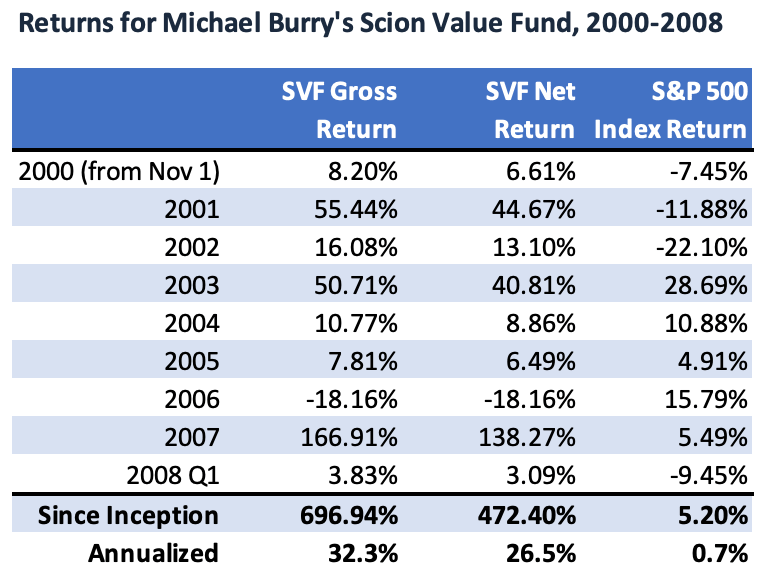
I could recount similar stories of hard work, love, and compulsion for Buffett and other investors too. But for now, recall the words of Stutz from earlier.
The need for constant work
There are three constants in life: pain, uncertainty, and the need for constant work. Let’s consider the last one.
First off, note that Stutz does not say that “constant work” is a part of everyone’s life. He says the “need” for it is, which implies that our work can be ignored for a period of time, even a long time, but by ignoring it we are depriving ourselves of our need for it. If we deprive ourselves of anything we need, we’ll suffer ill effects, and constant work, according to Stutz, is one of those things we need like food and water.
Second, Stutz is saying that each of those three things will always be with us. There is no escape from them.
Suddenly, the work Burry, Meyer, and the rest of us do, whatever kind, seems like less of a choice; work will always be with us and we have a need to do it. Recognizing this puts the work any of us do in a different light. The choices we make, career or otherwise, tend not to be clean or passive, whereby we look at ourselves in the mirror, and say “I love investing” or “I love restaurants,” and then go to work in that field. Rather, we are under constant bombardment from the work being thrown at us, and it is under this bombardment that we take up work, sometimes any work, to fulfill our need to do it.
The two groups
The point of all this is that the work we “choose” tends to involve less choice than we think. Once again, our lives involve a constant stream of unending work, according to Stutz, and we have a need to do it. That need compels us to start doing the work, whether it is work we enjoy or are compelled by or not.
But the greats somehow have found their way to the work they are compelled to do, in whatever way. In Meyer’s case, he had an uncle there to wake him up and give him permission, so to speak, to do the thing he was compelled to do. In Burry’s case, he somehow summoned a superhuman level of energy to study investing after working long shifts at the hospital; his Asperger’s seems to have helped with that to some degree. Some other greats start working their compulsions from an early age, which makes later life changes, like the ones Meyer and Burry needed to make, less necessary or difficult. Buffett springs to mind there.
There is a mental model I carry in my head for this: to some degree, people can be split into two groups, those doing what they are compelled to do and those who are not. All people have a constant stream of work being thrown at them at all times, and all people have a need to do the work.3 The greats, whether by bold choice or otherwise, are working in the streams that they have a natural compulsion to work in. In this model, those who don’t have a natural compulsion don’t have a chance because the relentless stream of work will eventually exhaust them. It is as if they are ordinary humans swimming in the rapids. From time to time, they can grab onto a rock and take a rest, but they will need to return to swimming, which they cannot keep up forever. They look over and see Danny Meyer with fins and gills.
What you find at the very tail end of the distribution, the top 1% of 1%… they tend to gravitate toward their calling intuitively. The reason why they do it is for the love of the craft itself. It’s a calling and they protect that purity.
- Dr. Gio Valiante on The Knowledge Project Podcast
Understanding my compulsion
By now, you can probably tell what I think. In order to be a truly great investor (or truly great at anything for that matter), the work must be a compulsion. It must be the thing I would be doing if I didn’t need to do it. An investor who wants to generate very high returns must be willing to turn over rock after rock in order to find the one best investment idea out of hundreds or thousands. There is no way to be great at such a game if you don’t feel a compulsion toward it, a love for it, a natural joy in waking up every day faced with the deluge of work. Thankfully, and not incidentally, the work of investing does feel compulsive for me.
I hope it does for you too, but if not, don’t fight the rapids. Maybe you have wings and are built to fly instead.
If you doubt Stutz’s claim, try considering it more. If someone springs to mind who doesn’t “need to constantly work,” for example, consider speaking with them. Are they truly “not working”, or is what you see as an easy life not seen as such by them at all? Maybe they’re free from one type of work but not from another.
Incidentally, the term “Asperger’s” is no longer used by medical professionals, who have merged the diagnosis with the more general “Autism Spectrum Disorder.”
Stutz also makes the point that nothing, not money, fame, or power, exempts anyone from the need for constant work. Here he is again in True and False Magic:
People believe money is the exonerating factor that will allow them to live on earth without dealing with pain, uncertainty, and the need for constant work.
You must keep doing what’s meaningful to you even if you don’t have to work anymore.
Michael Burry is one of my most admired investors too. I was shocked when people teased and even mocked his Substack with the argument being that he probably lost so much money that he now needs a newsletter to make money. Cassandra Unchained is not a cheap subscription but it’s worth every dollar we pay for.