


I once knew a colleague who had the bad habit of steadfastly refusing to say the words “I don’t know”. I mean that literally. Whenever someone asked him a question he didn’t know the answer to, he would reply “I can’t answer that”. I often watched as befuddled investors or clients heard his reply, stared blankly for a beat, and typically moved on. In the rare cases where someone would challenge the reply by asking “You can’t answer or you don’t know?”, he would simply repeat his mantra.
This real-life cartoon has served as a caricatured reminder to me over the years that saying “I don’t know” is not a sign of weakness, as I’m sure my colleague thought. For great investors, in fact, it is a critical skill to practice.
In a rare interview for Columbia Business School’s Graham & Dodd newsletter (Spring 2013), Li Lu expressed this sentiment well. The interviewer asks Li about real estate prices in China, which was a hot topic at the time given many new stories about the development (and overdevelopment) of some Chinese cities. Li’s response is refreshing.
G&D: Do you think real estate has gotten a little ahead of itself where there would be a need for a correction, or do you think that demand will just catch up?
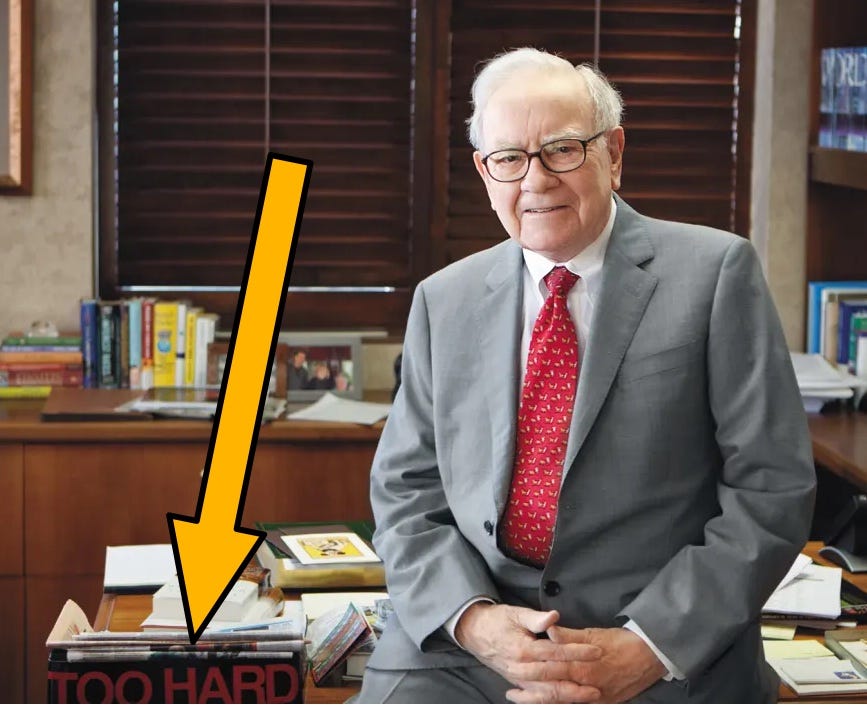
LL: I put that in the “too hard” basket. I also put in the basket of “I know I don’t have to know.” It certainly is “I don’t know”, but I also know that I don’t have to know! I don’t want those things to worry me.

Missing the lesson, the interviewer issues a similar follow-up question, and Li responds in the same way:
G&D: How do you view the overall attractiveness of equities today?
LL: I also put that into “too hard” and “I know I don’t have to know.” I only think about it when things go to an extreme. I don’t foresee that as going to the extreme, either way. In that case, I know I don’t have to know.
I also ran across this interview of Mohnish Pabrai in which he expresses the same idea. The interviewer, Stig Brodersen, asks about companies for which legal regulations, which are often nebulous, might be important. Stig explains that he would like to expand his circle of competence to better understand certain regulatory laws, but he finds it difficult. Mohnish responds by talking about humility and discipline:
One has to approach circle of competence with a lot of humility... it may be that that question [about regulations] leads to putting that business in the too hard pile... A lot of humans have difficulty with giving up. They don’t want to give up... And I think Buffett and Munger’s answer would be that 99% of businesses need to go in the too hard pile.

Why is it so important to say “I don’t know”? One reason is that truly great investment opportunities come along somewhat rarely and involve sorting through a ton of mediocre opportunities to find the great no-brainers for which “I don’t know” doesn’t even come into play.
These are investments like Microsoft in 2010 when the P/E was around 8x, which I wrote about last week, or one of my favorite no-brainer investments of all time, buying Apple around 12x in 2013 and 2014, when Carl Icahn went on CNBC to shout it from the rooftop and later wrote a public letter using the term “no-brainer” four times.
But there is a second, more subtle reason why “I don’t know” is important. Failing to practice humility as an investor, failure to say “I don’t know” for most questions you come across, is effectively practicing a bad habit, and every time we practice a bad habit, we weaken ourselves and become more comfortable practicing the bad habit.
The book Lessons for Living by psychiatrist Phil Stutz makes this point several times throughout it.
The impulses for all of our bad habits travel along the same path – a straight shot to immediate gratification through what I call the lower channel... Lower channel functioning is a disaster. When the pleasure is over, we’re left with nothing.
Failing to say “I don’t know” is a warped kind of pleasure seeking: it is our attempt to convince others (and ourselves) that we are competent, that we know more than we do. Failing to say “I don’t know” is failing to conquer our insecurity.
Stutz goes on to say that, on the other hand, every time we practice restraint and discipline over our bad habits, we reward ourselves with a kind of energy.
Every time you restrain your impulses, you close off the lower channel... And in this higher channel, the energy accrues. Every act of restraint puts more in the piggy bank.
The more we practice bad habits, the more we become comfortable with these bad habits and keep our brain stuck in a feedback loop: bad habit - quick, but hollow reward - bad habit.
But the more we resist our bad habits, the stronger our psyche becomes, the more energy and creativity we receive, and the easier it becomes to continue to practice good habits.
With that in mind, it becomes a little clearer why investors who practice discipline in investing are better off: they are reinforcing the discipline to act only when the great, big opportunities come in and to refrain from meaningless, compulsive action otherwise.
This psychology plays out with particular consequences in investing.
Most professional investors do not practice enough restraint. In fact, they are incentivized to do the opposite. The practice of charging a management fee, for example, incentivizes them to raise more money. And in order to raise money, they will be inclined to appear as experts to their clients, whose questions will be myriad and which the professional will feel compelled to have an opinion on.
“What will the effect of a ceasefire (or a prolonged war) in Iran be on your investment in XYZ Corp.?”
“Where are interest rates headed?”
“Isn’t the S&P 500 too richly valued at 28 times earnings?”
“Isn’t software company X going to thrive in the Age of AI because of their particular niche?”
There may be unique times when an investor has a very specific reason to have an opinion on questions like these, but most of the time, his answer should be something like “I don’t know. I’m looking for great investments where things like that won’t have a long-term impact”.
But how many professional investors do you think would have the wherewithal or courage to answer their limited partners in such a way? Instead, a smart-sounding opinion is easier to produce and seems like the safer bet. A confident and direct answer is the surest shot at attracting money from new clients or convincing existing clients to stay put.
But falling into the habit of producing opinions when we shouldn’t hurts us.
Perhaps worst of all, it reinforces to our brains that it is ok, even necessary, to have an opinion on everything, when a good investor should be practicing the exact opposite. When he finds something too hard to understand, he should move on. When he finds something he can grasp, he should restrain his opinion until he has done enough research. His job is to work continuously to find the great investments that do not require an opinion on stuff that’s too hard to understand.
“I have what I call an iron prescription that helps me keep sane when I naturally drift toward preferring one ideology over another. And that is I say ‘I’m not entitled to have an opinion on this subject unless I can state the arguments against my position better than the people do who are supporting it.’ I think only when I reach that stage am I qualified to speak.”
- Charlie Munger, USC Commencement Speech, 2007
Spot on. In general, successful investors are an extremely confident bunch. Their success, however, doesn’t come from knowing the answer but from continually asking questions and wrestling with the unknown and unknowable future.