


The price of a stock varies inversely with the thickness of its research file. The fattest files are found in the stocks that are the most troublesome and will decline the furthest. The thinnest files are reserved for stocks that appreciate the most. This kind of file generally consists of a single prospectus.
- Martin T. Sosnoff, Humble on Wall Street1
Perhaps it’s overstated slightly, but there is something interesting and true in the above quote. The best investment ideas, I’ve found, are usually the ones that can be explained in a short paragraph and sometimes just one or two sentences.
So much of professional money management makes it seem otherwise. Impressive-sounding stock pitches abound, and, to an untrained eye, it can feel like longer investment cases mean better investment cases, but I generally don’t believe that.
By studying great investments from the past, I’ve come across many examples. Here are a few:
Carl Icahn’s investment in Apple starting in 2013 (and Warren Buffett’s investment starting in 2016)
On August 13, 2013, Carl Icahn announced on Twitter that he had begun buying shares of Apple, saying he believed the company was extremely undervalued.

On October 23 of that year, he released a public letter to Apple’s CEO, Tim Cook, explaining his reasoning. Icahn later followed up his letter with five more, the most interesting of which was his letter to shareholders on January 23 of the following year in which he discussed his rationale for investing in Apple.
Icahn’s letter comes in at just over 3,000 words, but the key point can be summarized in just two sentences: Apple is the premier consumer products company in the world, and the price of its stock implies that it is trading at a discount (versus the earnings it produces) relative to the rest of the S&P 500. Furthermore, a potential catalyst exists to close this gap: returning some of Apple’s excess capital to shareholders via stock repurchases. Here is a sample from his letter:
In our opinion, a great example of a “no brainer” in today’s market is Apple. The S&P 500’s price to earnings multiple is 71% higher than Apple’s, and if Apple were simply valued at the same multiple, its share price would be $840, which is 52% higher than its current price. This is a dramatic valuation disconnect that simply makes no sense to us
[…]
Given the degree to which Apple appears undervalued to us, we almost feel that it’s a waste of time to debate the point. As we believe it to be the preeminent and most innovative consumer products company in the world, with the greatest brand, hardware, software, and services in the world, Apple has had tremendous growth to date, and we fail to see why this growth would not continue moving forward.
The rest of Icahn’s letter is secondary: he spends time making the case that it would not be imprudent for the company to be even more aggressive with its share repurchase program, and he walks through the tremendous potential he believes Apple has to develop new products and increase earnings even further. But his main point was a simple one. Apple was perhaps the best company in the world, trading at a discount to other companies.
Icahn initially purchased 3,875,063 shares of Apple in Q3 2013, per his 13F filing at the time. He continued accumulating the stock through the beginning of 2014, even as it moved higher, disclosing on January 23 that his position had reached $3.6 billion. His 13F for the first quarter reported that he owned 7,537,264 shares. (On June 9, Apple’s stock split 7-for-1, giving Icahn 52,760,848 shares, the number he reported for the second quarter.) He described his investment in Apple as “the largest position in our investment history”.
Icahn eventually sold the position, disclosing the sale to CNBC on April 28, 2016 and reporting that he made $2 billion on his investment. Although he never disclosed his cost basis, I estimate Icahn made total return of about 40-50% over the 2+ years that he owned the stock.
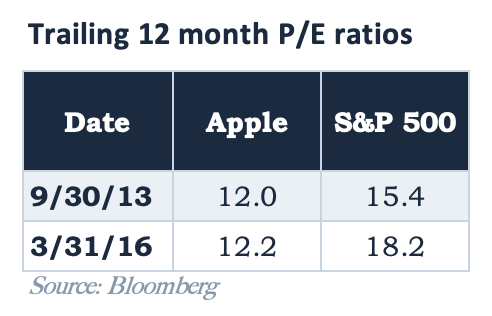
His investment was a success, but ironically, he seems to have forgotten his own simple thesis upon selling the stock. Although the valuation disconnect with the S&P 500 had closed as Apple’s stock ran up in 2014, the stock had actually declined during 2015, and by April of 2016, around the time Icahn sold his stock, the valuation discount was even greater than when he started buying.
When asked why he sold the position, he cited antagonism from the Chinese government, which was making it difficult for Apple to sell products there, as the main reason. In his initial letters, China wasn’t mentioned at all, and one could argue that his thesis was still solidly intact: Apple was still one of the best companies in the world, and the future remained bright.
This kind of in-the-moment anxiety or frustration happens to all investors, even some of the best, like Icahn. And it is another benefit to having a simple investment thesis. When the inevitable worries come along and the stock’s price has dropped, having a clear and simple thesis to question can help an investor see whether Mr. Market is merely overreacting or not.
Interestingly, at almost the same time Icahn was selling his investment in Apple, Warren Buffett was starting to accumulate a position in the stock. Berkshire Hathaway reported owning 9,811,747 shares of the company as of Q1 2016 and kept buying through 2016, ’17, and ’18, eventually owning over 250 million shares by Q2 2018.2
Although Buffett’s comments are sparse regarding exactly why he made the investment in Apple, in a few interviews, he cited the extraordinary franchise and moat that the company commanded. From a CNBC interview in 2018:
“Apple has an extraordinary consumer franchise,” he said. “I see how strong that ecosystem is, to an extraordinary degree. … You are very, very, very locked in, at least psychologically and mentally, to the product you are using. [iPhone] is a very sticky product.”
I could not find any direct quotes made by Buffett on the price of Apple’s stock at the time he made his purchases, but the table above tells the story: at the end of Q1 2016, when Berkshire began making its purchases, Apple’s TTM P/E ratio was 12.2 versus 18.2 for the S&P 500. The Apple discount persisted until 2019.
I suspect Buffett’s thesis for investing in Apple was as simple as Icahn’s a few years earlier. He believed Apple was an incredible company with a very strong moat, that its earnings would continue growing, and that buying it at an 8.2% current earnings yield was a great bargain.3
Peter Thiel’s investment in Facebook in 2004
Peter Thiel has described the investment he made in Facebook in 2004 in several interviews, and by those accounts, the decision to invest was a clear one, and he made it quickly.
Why did he invest in the company? Thiel describes a situation that was “straightforward”: Facebook was already doing very well. Here is he in an interview with Bill Kristol:
…people always ask was [it] extremely hard to figure out how to invest in Facebook when I did it in [2004]. At the time, it felt like a relatively straightforward investment. They were already on 20 college campuses.
[Mark Zuckerberg is] in California summer of 04 looking for investors. And my friend, Reid Hoffman, who started LinkedIn, and I ran across Zuckerberg and basically decided to give him another half million or so dollars to scale it. It was generally a good sign when the only thing you needed money for was to buy more computers because there was such demand for the product.
In another interview with Dave Rubin, Thiel repeats the sentiment with some more color.

He reports that his first meeting with Zuckerberg was not sophisticated or complicated at all. Zuckerberg was nineteen years old at the time, and Thiel saw that Facebook already had a rapidly growing product.
…the main thing he had going for him was that they were just growing really fast. They were at something like twenty college campuses. They had about 100,000 people on the network, and they just needed more money for computers because there was such demand for the product as they were going to launch at more colleges in the Fall.
…It was already working.
One also gets the sense that Thiel realized he was in a goldilocks zone, not so early that the product was a long shot and not so late that Zuckerberg was already well funded. He did not know Zuckerberg before meeting him for the first time, but it did not stop him from agreeing to invest in Facebook on the spot. Thiel realized that the most prudent thing to do after that brief first meeting was to act quickly. From the Rubin interview:
We told him to leave for an hour. Then he came back and we gave him a term sheet about an hour later. It was a fast decision.
Thiel did not ask Zuckerberg for more information. He did not set a follow-up meeting. He did not tell him he would get back to him in a week. He realized that the thing that mattered more to the investment than anything else (was it growing like wildfire among its first users?) had already been proven to him. All he had to do was give Zuckerberg the money he needed to allow the growth to continue.4
Charlie Munger’s investment in Tenneco stock and bonds
At the 2017 annual meeting of the Daily Journal Corp., Munger told an alluring story about his investment in the stock and bonds of automotive parts maker, Tenneco. Munger’s recounting of the investment captivated the audience but lacked a lot of detail, so I researched what he saw at the time and wrote about it earlier this year.
Munger’s commentary implied that the stock was simply cheap on the basis of Tenneco’s sticky business:
It was a cigar butt... It was [the maker of the] Monroe shock absorber...
[…]
I kind of knew based on experience how sticky some of that auto secondary market was, and how many old cars needed Monroe shock absorbers, and I just knew it was too cheap. I didn’t know it would work for sure but I knew [it was cheap].
Furthermore, when asked by an audience member how long it took him to make the decision to invest, Munger replied, “Oh, about an hour and a half.”
After researching the investment, I was surprised to find that Munger could make the decision that quickly. Tenneco was not simply a great company with a stock that was cheap; it was also on the verge of bankruptcy. I concluded that Munger must have reasoned that the best course of action for the company and its lenders would not be a liquidation, but, based partly on its hidden, underlying profitability, a recapitalization would be better and would leave the current equity holders with much more value than the price of the stock suggested.
I think Munger likely reasoned about how a potential bankruptcy might play out, and I think this was the most important point of all, prompting him to make his investment.
If Tenneco was forced into bankruptcy, its lenders would then have to decide on the best course of action that might get them a full recovery on their lending amounts. The total amount of long-term debt outstanding was $989mn plus the $500mn of subordinate bonds which Munger would invest in.
Tenneco’s lenders would rightly ask themselves: How are we best off to recover our $989mn?
[…]
We could effectively realize the value of those brands by recapitalizing the company and operating as usual. One way to do that might be to forgive Tenneco’s debt completely, take an equity stake in the new company without debt, and then sell the equity in the new company to make ourselves whole on the lending amounts.
Now, you might argue that only an investor as brilliant as Munger could sort all this out in an hour and a half, and I wouldn’t argue with that. But the overall lesson still holds. It may take a genius investor 90 minutes to distill the major driver upon which the success of an investment hinges, or it may take a lesser person a full day or two. But agonizing over the fate of Tenneco by seeking more and more information would have been a waste of time.
Munger did not attempt to divine whether the recession underway at the time would abate. He did not attempt to call colleagues or friends or do channel checks to see how Tenneco’s sales were progressing that quarter.
He developed a simple and solid thesis: the company still produced valuable products and did so profitably (under the right balance sheet capitalization), and that made the debt and equity worth much more than the market was indicating.
He also realized he could be wrong and that sizing his bet appropriately was just as important as the thesis. I estimate that he bet roughly anywhere from $11 million to $18 million on Tenneco’s stock and bonds, which would have been on the order of 1% of his net worth. He made about $80 million on the investment.
Some lessons
I have many more examples than these three, but part of the reason I like these ones is that they are sufficiently different from one another. Icahn and Buffett invested in a great company at a low price, Thiel’s investment was in a startup company but one that already had a huge amount of risk removed, and Munger’s investment was based on Tenneco simply having more value than the extreme price declines indicated.
There are a few lessons I take from these examples and many others.
First, in situations like these, I’ve found it very tempting to drown myself in information to avoid the pain of making a decision, but doing so would be a big mistake. Excessive research can become a form of avoidance, a place to hide from the fear of choosing a path. Ultimately, it can be more harmful than making the decision.
Second, I should be skeptical of investment ideas or pitches that require a lot of explication. As more information is needed for an investment thesis to go right, the risk increases that one of those pieces will go the wrong way and confound the investment. In addition, a more complex thesis is likely to confuse the investor as the environment inevitably changes in the future. If there are more factors that you believe your investment hinges on, there will be more chances you’ll see a boogeyman in one of them and bail out when you should be holding (or, like Icahn should have done, even adding to your investment).
From time to time, I’ll come across investment pitch decks that are 50 or 100 pages long, some even longer than that. What could possibly be said on page 92 of a slide deck that could be important to the investment thesis? How could one be sure of every piece of information on pages 1 to 91? Instead, I tend to think that overly complicated investment theses are designed to impress one’s clients or limited partners (or even to trick oneself). It is harder for a client to criticize an investor when the investor has clearly put in a lot of work, and it may seem cruel to suggest that all that effort was misplaced.
Third, the existence of simple and great investments from the past pairs well with the punch-card mentality of investing, which I think the vast majority of individual investors would do well to remember. If I find myself struggling to understand an investment thesis, straining with assumptions whose validity is unclear, or wrestling with relative value and whether or not an investment might qualify as cheap, I am better off saying no. If you have trouble with that, just remember…
You only have to get rich once.
- Charlie Munger
Sosnoff, Martin T. Humble on Wall Street. Arlington House Publishers, 1975, p. 69.
Apple stock would split 4-for-1 on August 31, 2020, and Berkshire reported owning over 944 million shares as of Q3 2020.
While the vast majority of Berkshire’s investment in Apple was Buffett’s decision, he has also said that the first investment of 10 million or so shares was made by one of his deputies, which I surmise was Ted Weschler.