


In Part One, we looked at AutoZone through its 1996 10-K and found a business that was growing consistently, earning improving margins, and generating high returns on capital. The financial picture was compelling on its own. But Eddie Lampert had to figure out whether the company’s runway was long enough to keep that performance going.
Part Three is now available as well.
AutoZone and the auto parts market
From AutoZone’s financial statements, it seems like the company was doing very well in 1996. It was running a very profitable set of 1,423 stores and it had been growing its store base at higher rates each year while the company’s profitability actually got better. That is a strong indication that management’s investment in new stores was paying off very well. AutoZone grew its store count by 3.6 times in just nine years, from 396 stores in 1987 to 1,423 in 1996.
But would that growth and performance be likely to continue into the future? How could Lampert be sure that the great trends would be maintained?
To understand the answer to that question, let’s look at the competitive landscape of the auto parts retailing industry. We’ll start with this quote from the 1996 10-K:
The Company competes principally in the D-I-Y and, more recently, the commercial automotive aftermarket. Although the number of competitors and the level of competition experienced by AutoZone’s stores varies by market area, the automotive-aftermarket is highly fragmented and generally very competitive. The Company believes that the largest share of the automotive-aftermarket is held by independently owned jobber stores which, while principally selling to wholesale accounts, have significant D-I-Y sales. [...] The principal competitive factors which affect the Company’s business are store location, customer service, product selection and quality, and price.
There are two parts of that statement that are most important:
the automotive aftermarket industry was “highly fragmented”, and
the largest share of it was held by “independently owned jobber stores”, which I think of as mom and pop owners or, in some cases, very small franchises.
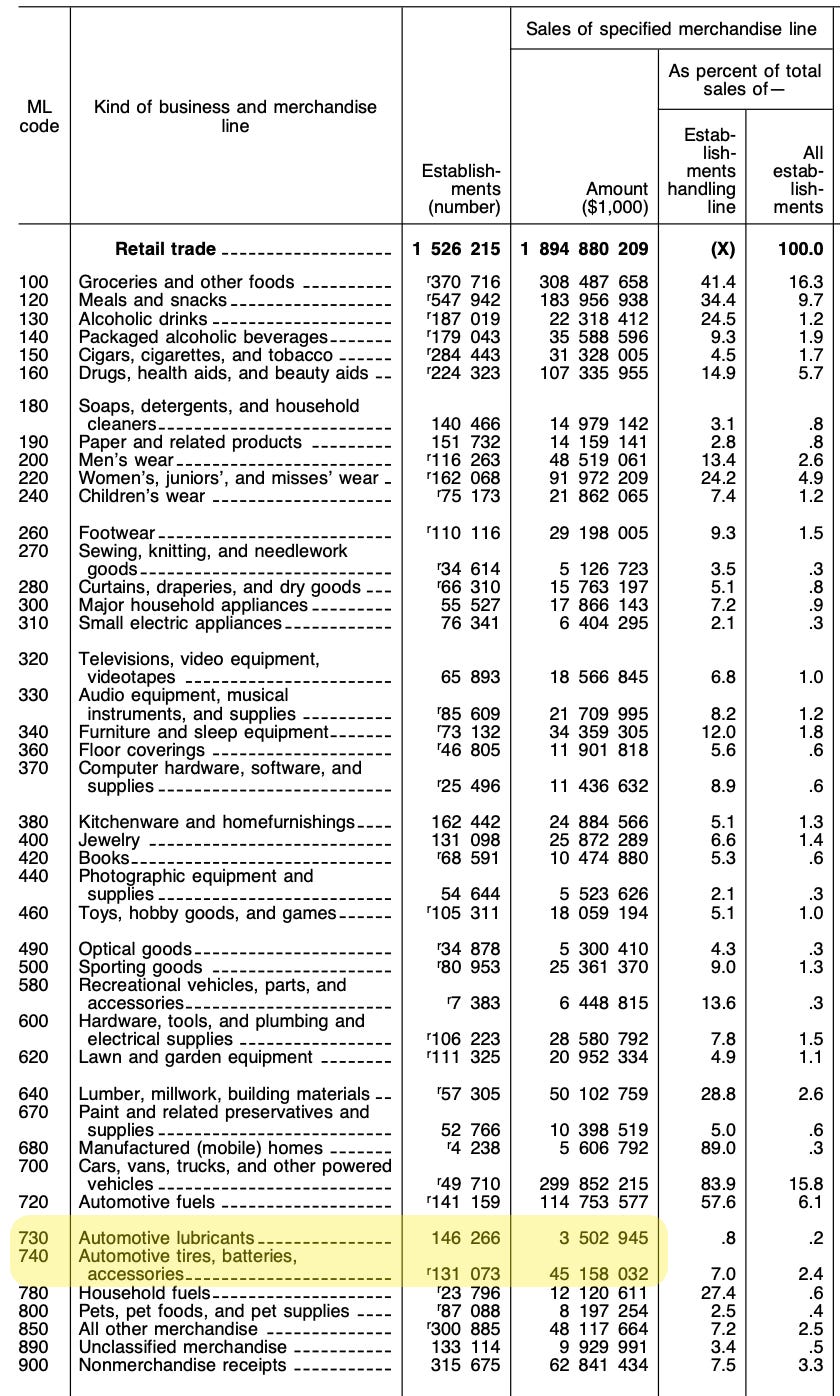
In order to get a feel for how large the auto parts retail industry was and how much of it was being served by AutoZone, I’ll reference the 1992 Census of Retail Trade in the US.1 The Census data is very comprehensive; the 1992 report is 87 pages long and full of data on every page. There are a few pieces of information there that are relevant for us in sizing up the retail auto parts industry. Table 1 of the Census summarizes all the data in the report, and it lists $45.1 billion in sales of “Automotive tires, batteries, accessories” and $3.5 billion of “Automotive lubricants”, for a total of $48.6 billion of automotive parts sales.
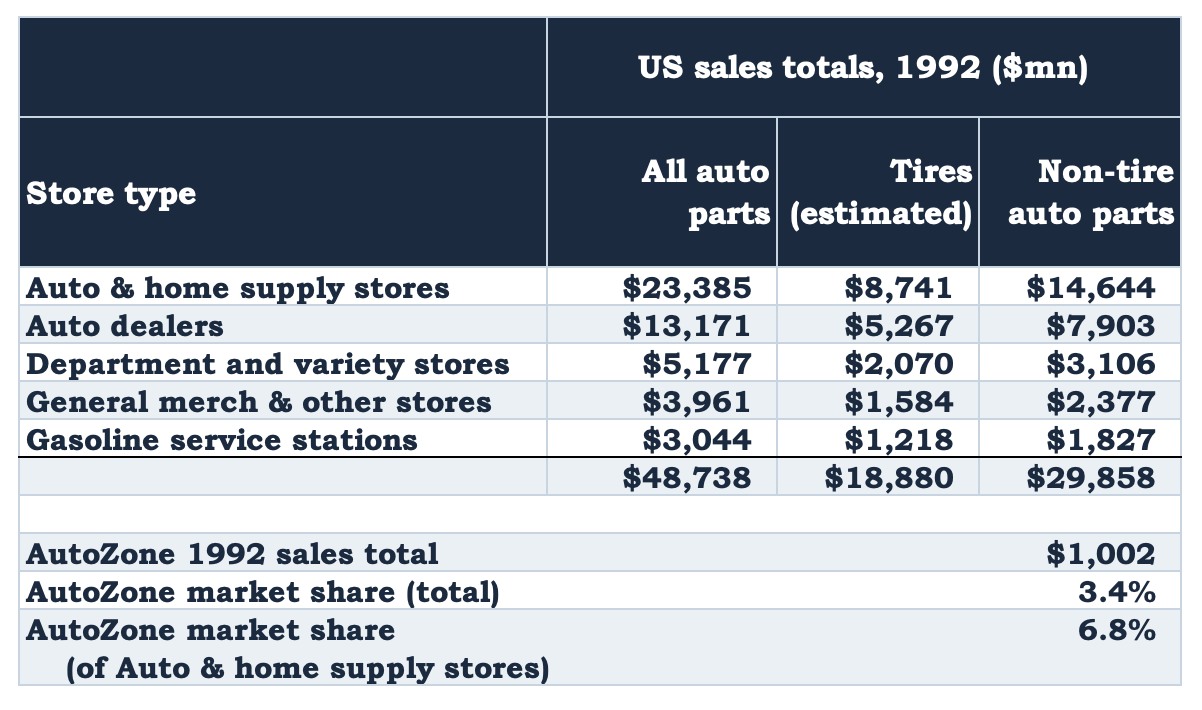
Now, AutoZone was not in the business of selling tires. So, from that $48.6 billion total figure, I need an estimate for how much of it was tire sales in 1992. Another public report, the Economic Analysis of the Rubber Tire Manufacturing MACT, lists the wholesale amount of 1992 tires sales in the US as $13.0 billion. From that figure, I estimate roughly that retail tire sales were about $18.9 billion in the US that year.2 The table below summarizes these figures, and it suggests that AutoZone was competing in an auto parts retail market (ex-tire sales) that had roughly $29.9 billion in sales in 1992.
AutoZone only had a small market share in 1997
Now, out of that total market of $29.9 billion, AutoZone’s 1992 sales total was just over $1 billion, which suggests that the company had captured only 3.4% of the total market (ex-tires). One could also restrict the analysis to “Auto & home supply stores” (nomenclature from the Census data), of which AutoZone was a part, and there the company had a 6.8% market share. (I lean toward the first comparison because AutoZone seemed to be so effective that it was disrupting all auto parts retailers.)
So that’s the 1992 data. What about 1996? It’s possible that Lampert had access to that more recent retail sales data, but I could not find any that would have been available at that time. No problem. We can simply walk the retail sales data forward, using CPI inflation data, to get a better sense as to AutoZone’s market share around 1996. It’s crude, but it gives a sense of where AutoZone was at the time in its quest to increase market share.
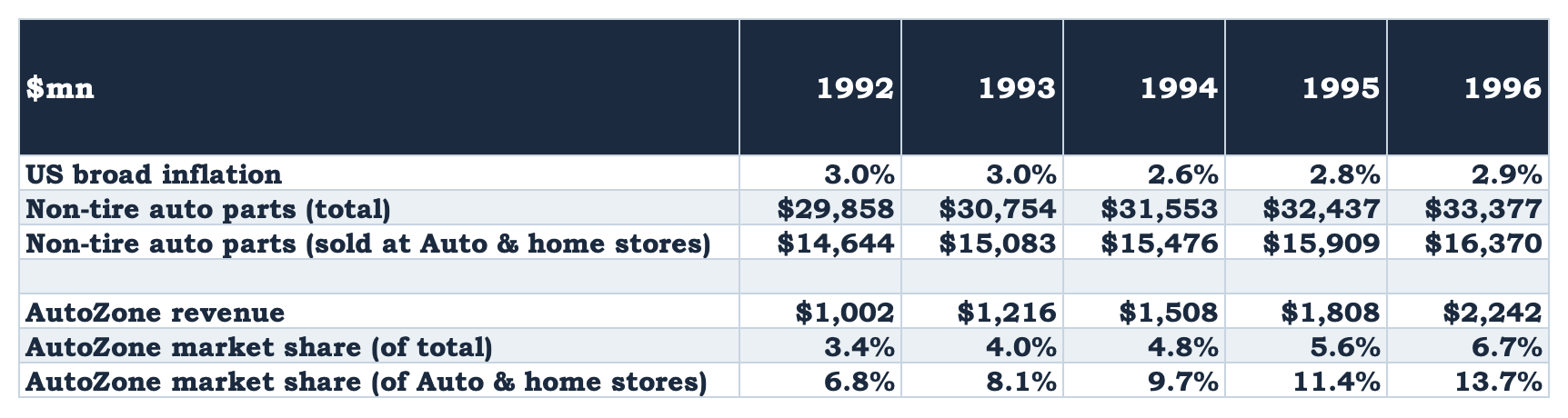
I estimate that, as of 1996, AutoZone had approximately only a 6.7% market share of the larger auto parts retailing industry (ex-tires). In the more restricted “auto and home supply stores”, which were direct competitors to AutoZone, the company had a 13.7% share. Using either measure, AutoZone seemed to have a very small portion of a market in which it was continually bringing a better offering to customers.
The retail auto parts industry was highly fragmented, with few large competitors and a lot of smaller competitors
As I discussed earlier, the auto parts retail industry was highly fragmented, and indeed, the Census data suggest as much: auto parts were sold by a variety of stores. And from researching public filings, newspapers, and trade publications, it was apparent that AutoZone did have a lot of competitors, but none of those competitors had more than about 10% of the market, at the very most.
Sears
The primary competitor at the time seems to have been Sears (the department store operator ran auto retail shops as well), whose operations were fragmented even within the company itself. Sears had five different auto retailing operations: (1) Sears Auto Centers, (2) Tire America, (3) NTW stores, (4) Western Auto stores, and (5) Parts America stores.
Sears reported total merchandise and service sales of $33.8 billion in its 1996 10-K. It did not break out its retail auto sales alone, but it did report the sales totals for its “off-the-mall” stores, which was composed of both Sears’ Auto business and Home business. Off-the-mall store sales totaled $6.3 billion in 1996, so I deduce that the retail auto business of Sears generated less than that amount. A reasonable estimate might be something like $3-4 billion (which includes tire sales). That figure can be compared to total auto retail sales in the US of $48.7 billion (back in 1992). So, Sears seems to have commanded a market share in the high-single digits percent.
Pep Boys
Pep Boys, which was founded in 1921 and which had been a public company since 1946, appears to have been doing rather well around the time Lampert was considering his AutoZone investment. In their 10-K for the year ended February 1997, they reported total revenue of $1.8 billion, of which $273 million came from service revenue and the balance from merchandise sales (compared to AutoZone’s $2.2 billion which was entirely from merchandise). Revenues had grown at a 4-year CAGR of 12%, less than AutoZone’s 22%.
O’Reilly Auto Parts
I mention O’Reilly Auto Parts here because many investors know it today as another great auto parts retailer. At the time of Lampert’s investment, O’Reilly was performing well too, but it was much smaller than AutoZone (or Pep Boys), with 1996 revenue of $259 million. Revenues had grown at a 4-year CAGR of 24%, which was comparable to the rate at which AutoZone had grown.
Others
Of course, those three names are not nearly all the competitors that sold auto parts to the retail market in 1997. There were many other names, including Wal-Mart, Montgomery Ward, Penske Auto Centers (Kmart), Caldor, PACCAR and a variety of other companies and stores, and none of them seemed to have very large part of the industry.
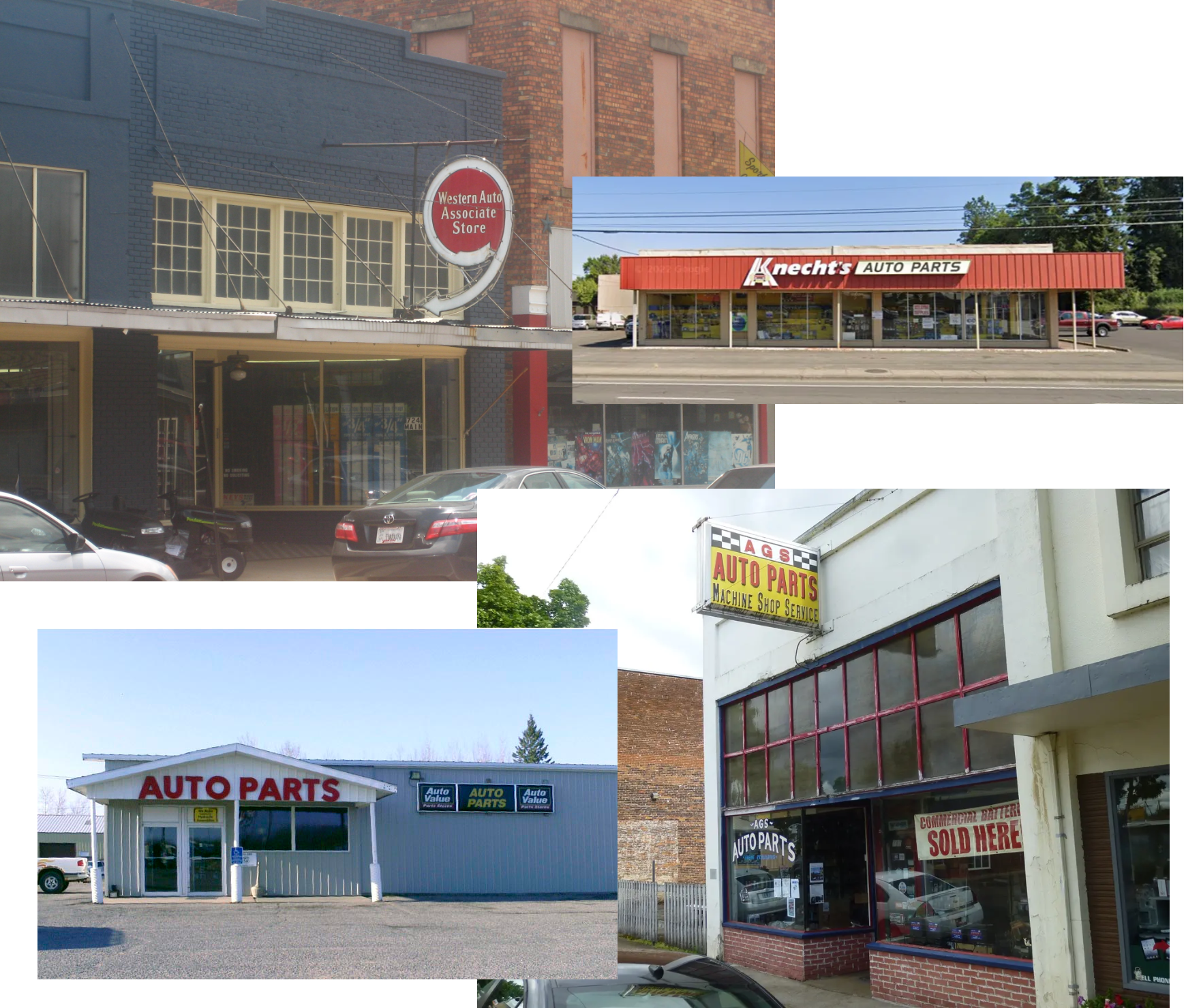
Most importantly of all, the industry had a large smattering of “independent” retailers, small shops around the US run by mom and pop owners. This group, as a whole, seemed to make up the majority of auto parts retail sales in the US in 1997.
AutoZone’s competitive strategy was compelling
I think of AutoZone’s competitors as falling into one of three types:
larger and more diversified retailers, like Sears,
smaller auto parts retailers (mom and pop shops or “jobbers”) that did not have scale, and
dedicated auto parts retailers (like Pep Boys or O’Reilly, that were smaller than AutoZone).
Let’s discuss the first two in more detail. (The third group were, for the most part, executing a similar overall strategy as AutoZone. But AutoZone seemed to have a head start over the smaller companies, like O’Reilly, and it seemed to be growing faster than and outperforming Pep Boys. At the very least, I assume Lampert’s view at the time was that firms like this might do well in the future and might have to share the large pie they were all attacking.)
Large retailers were complacent and unfocused...
For the large retailers, AutoZone’s proposition was that the company could do a better job by focusing on a single line of business (auto parts retailing) than those diversified retailers for whom auto parts was one of many businesses. As far as its competition with Sears, AutoZone’s strategy seemed to be working as of 1997.3
Sears Automotive Group has certainly had its ups and downs. The auto parts and services division of the $38 billion retailer boasts more than 1,100 stores, popular brand-name products like DieHard batteries, and a place among the top five automotive aftermarket retailers. But Sears Automotive has been growing more slowly than the industry, going from sales of 24 million tires and 8 million batteries in 1994 to just 25 million tires and 8.5 million batteries two years later. The group last year closed 69 of its Western Auto outlets and lost a reported $300 million in revenue when those tire stores were merged into Sears’ existing tire chain. Then there were the accusations several years ago that its service-store technicians were recommending unnecessary repairs.
Not only were sales growing more slowly at Sears, they were in year-over-year declines as reported in the company’s 10-Q from 1997 Q2:
Auto Stores, consisting of the Sears Tire Group and Parts Group, experienced revenue declines in the low single digits from the same period a year ago as comparable store sales were down from prior year. During the first quarter Sears Tire Group announced plans to convert its Tire America and NTW stores into a single format, “National Tire and Battery” (NTB) as part of the continued expansion of automotive off-the-mall concepts.
Once again, I am reminded of a passage from Sam Walton’s autobiography, whereby he expresses disbelief that the existing, large retailers did not simply adopt Wal-Mart’s strategies and kill the young company. Ultimately, however, they were too complacent to change:4
Now, most of these guys already had distribution centers and systems in place, or we had to build one from scratch. So on paper, we really didn’t stand a chance. What happened was that they didn’t really commit to discounting [the better, Wal-Mart model of retailing]... They were so accustomed to getting a 45 percent markup, they never let it go. It was hard for them to take a blouse they’ve been selling for $8.00, and sell it for $5.00, and only make 30%. With our low costs, our low expense structures, and our low prices, we were ending an era in the heartland.
...And small retailers were suffering from their lack of scale
So, for the large retailers, the inability or difficulty in competing with AutoZone was a symptom of large corporate culture. On the other hand, for the small retailers, the inability to compete was much more cut and dried:
Small shops could not match AutoZone’s merchandise selection, store experience, customer service, and prices.
Finding proof of that is more difficult than searching the filings of large, public companies, but I was able to find some evidence in trade publications from the time. Here is one article discussing a franchisor (Auto Aid Stores) criticizing the refusal of his own mom and pop franchisee owners to adapt, while the mom and pop owners criticize the franchisor for being uncompetitive in pricing:5
When Philip Stephen looks at the future of the auto parts business, he sees big stores, large selections and discount prices. When he looks around his own Aid Auto Stores, he sees mom-and-pop operators running dirty stores and stocking shelves full of antifreeze in the heat of August. With his eye on the growing but competitive parts business, and with money from a $9 million public offering, Aid Auto’s chief executive is on a fast track to convert his 40-year-old franchising network into a company-owned operation.
[...]
Mr. Stephen contends that troubled franchisees have only themselves to blame. “They’ve been doing business the same way for 40 years,” he says. He adds that too many stores appear shabby and are falling behind on payments to the warehouse. In the past two years, Mr. Stephen has terminated franchise agreements with 25 stores. But the franchisees tell a different story. They say Mr. Stephen charges 5% to 20% more than other warehouses for the same goods, forcing them into bad financial shape so he can take back the territory. Advertising has dropped from weekly inserts in the Daily News to a monthly circular.
And here is another article describing a small auto parts retailer in Ohio effectively admitting that he cannot compete on price with the ever-expanding AutoZone (and some other large retailers):6
An independent operator of three area stores, Bernard’s Auto Parts was founded by Jerry’s father in 1948. True enough, he says, recent years have brought great competitive pressures-the AutoZone, Pep Boys and Western Auto chains have opened numerous area stores--but small operators can survive if they focus on service. “These big chains are like any other new business that starts,” Bernard observes. “They have real nice prices in the beginning to get a market share--you make a bang for a year or two. But at some point in time, you have to raise prices.”
As we saw in AutoZone’s financials, with their high levels of profitability, the above critique is wrong. The company was not simply loss-leading in an attempt to gain market share.
For this part of the research, it may be difficult to imagine doing this work back in 1997. Some of the AutoZone’s value proposition to the customer is qualitative rather than quantitative (like having cleaner stores versus mom and pop and the attractive layout and design of stores). These trade journal articles provide some evidence, but it’s important to note that in-person scuttlebutt was an important part of Lampert’s research at the time. From the BusinessWeek article on Lampert from 2004:7
[ESL analyst Daniel] Pike recalls getting a taste of Lampert’s methods when he applied to work there after quitting an investment-banking job at about the time ESL was investing in AutoZone. Before hiring Pike, Lampert sent him on a grueling, all-expenses-paid field trip to visit auto-parts retailers throughout the country for a month to test his smarts.
Although I cannot prove it, I’m inclined to think this scuttlebutt was not just one part of Lampert’s work, but was critical research that actually proved to him that what he was seeing in AutoZone’s financials was real; AutoZone’s stores were head and shoulders better than the competition, and this is why the company was so profitable.
AutoZone was well-positioned to continue growing revenue and earnings
Now the opportunity that AutoZone had in front of it begins to become apparent. The company was positioning itself in the middle, so to speak, between large, diversified retailers on one hand and small mom and pop jobber shops on the other.
Large retailers were having trouble competing with AutoZone because AutoZone, by being a monoline retailer focused on auto parts, could offer better service to its customers.
Small retailers were having trouble competing because AutoZone’s scale allowed it to be more profitable than those businesses, which allowed it the capital to create better stores with more selection, better service, and lower prices.
Critically, the industry was so fragmented and AutoZone’s market share was so low in 1997 (around 6.7% of the non-tire auto parts retail market) that the company seemed to have a long runway of growth ahead of it.
The 1996 10-K shows the company was only in 27 states out of 50 in the US, and notably not yet in California or New York:
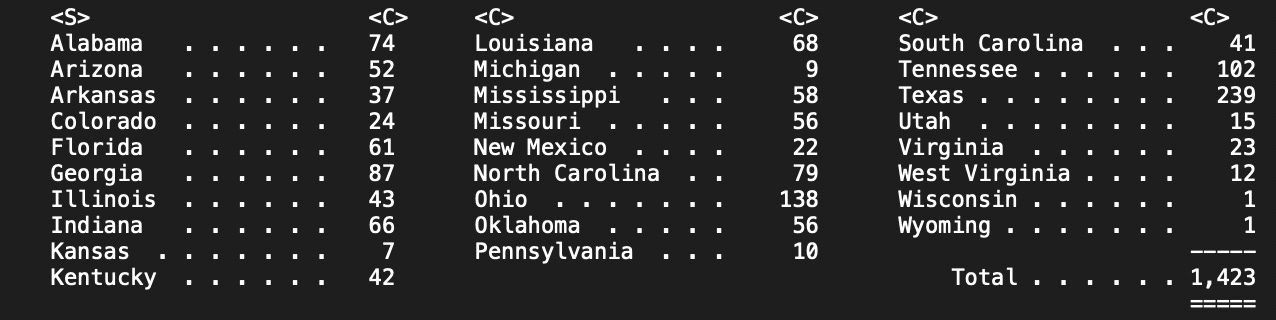
The same report also showed no signs that their expansion was slowing:
For the past several years, AutoZone’s record store openings have outpaced the competition by a wide margin. And we see no reason why fiscal 1997 should be any different. We are projecting a record 335 new stores for this coming fiscal year.
So the qualitative case was strong: a differentiated retailer, in a fragmented industry, with weak competition above and below it, and a market share low enough to grow into for years. The question Lampert still had to answer was a quantitative one. If AutoZone simply kept doing what it was doing, opening stores, taking share, financing the expansion, what could the business actually look like five years out, and what would that mean for the stock?
Part Three will answer those questions next week.
Case studies can often make an investment seem easier than they would have been at the time of investment, and a good case study should be careful to eliminate biases so the investment decision is as faithful to the past as possible. However, sometimes, case studies can be more difficult than at the time of investment because information sources that were available in the past may no longer be available. I suspect that is the case with the work I did on the auto parts retail business. The 1992 Census data is valuable and comprehensive, but I suspect Lampert would have had access to some trade publications or Wall Street research that more directly showed him the market share of auto parts retailers at the time.
For excellent bedtime reading, the Economic Analysis of the Rubber Tire Manufacturing MACT can be seen here. It lists $11.8 billion in US tire sales in 1992, but that figure is a factory-gate value. Up-charging with an additional 60% provides us with our rough estimate of $18.9 billion. This report came out in the year 2000, so Lampert (or we at the time) would not have had access to it, but I assume he had access to some other comparable data (perhaps from Wall Street analysts covering the auto retail market that could provide total sales data or retail industry trade publications or tire industry analysis).
Where the Rubber Meets the Road, Datamation.com, August 1997.
Made in America by Sam Walton with John Huey. Chapter 8.
Retail rough rider: Aid Auto chief in expansion overdrive; Siting of stores, pricing rile franchises, Crain’s New York Business, March 4, 1996.
Worldwide gets new name, creditors get stiffed, The Business Journal (Youngstown, OH), April 1997.
The Next Warren Buffett?, BusinessWeek, November 22, 2004.
Thanks for this
Thanks for developing this case study. This industry is fascinating as it's not about anything new, indeed just the retailing of auto parts--yet the rewards to investors in Auto Zone and O'Reilly have been nothing short of spectacular. I am still surprised by the levels of profitability in this retail sector!
I came across Auto Zone in the mid 2000s, but steered away due to the high, and increasing debt the company took on to buy back shares, and I perceived this as simple financial engineering in hopes of a short-term pop at the risk of increased financial fragility.
I instead bought O'Reilly, and that was early enough to be able to talk to the CEO on his cellphone en route to a store visit. My big regret was selling much too soon, as the company appeared substantially overvalued on several different valuation approaches. It would have been much better to not have sold at all, or at least to have just trimmed the position.
Fortunately, I learned my lesson, and have held MasterCard and Visa since the late 2000s. :-)