


In Parts One and Two, we built the case that AutoZone was an excellent business with a long runway in a fragmented industry. The 1996 financials showed a company growing 20-25% per year on improving margins, and the competitive landscape, with Sears in slow decline above, mom-and-pop jobbers without scale below, suggested that runway was real. AutoZone held perhaps 6-7% of a $30 billion non-tire auto parts retail market and was opening stores at a record pace. With that backdrop in mind, we can now turn to the question that ultimately mattered for Lampert: what would the next five to fifteen years actually look like?
What could AutoZone look like in the future?
Given the positive backdrop, let’s try to construct a pro forma income statement for AutoZone that might show what the future could look like for the company. Such an income statement can help us understand what I expect to see as the company progresses.
In trying to imagine the company’s future, I’ll make two important estimates: one for how the company’s revenue might grow and one for how much capital the company will consume in opening new stores, financing this growth. We’ll start with the second.
AutoZone’s capital consumption
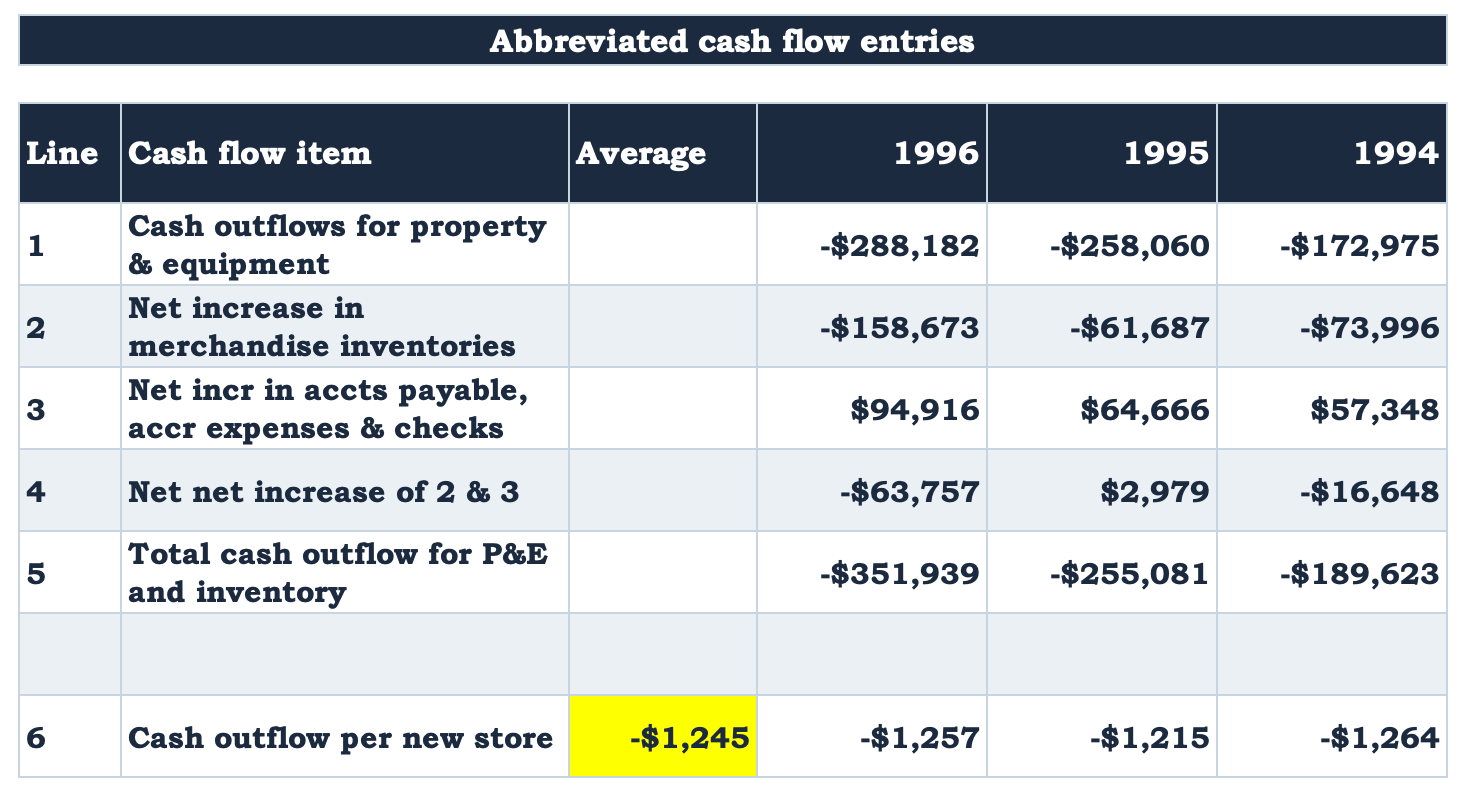
In estimating how much capital AutoZone needs to open new stores, the company’s cash flow statement holds the key. Very basically, the creation of a new store involves two uses of capital: one slug for the purchase of land, creation of the building, and purchase of any equipment needed and one slug for the merchandise inventory with which to stock the store. Furthermore, company filings indicate that AutoZone has been able to lower the net cost of new merchandise inventory by negotiating favorable payment terms (which is essentially the extension of credit) with suppliers. From the 1996 10-K:
The Company’s new store development program requires significant working capital, principally for inventories. Historically, the Company has negotiated extended payment terms from suppliers, minimizing the working capital required by its expansion. The Company believes that it will be able to continue financing much of its inventory growth by favorable payment terms from suppliers.
The table below shows an abbreviated version of AutoZone’s abbreviated cash flow statements and highlights the amount of capital AutoZone required to open each new store from 1994 to 1996. That amount is $1.245 million, highlighted in yellow. (We’ll use $1.3 million in making our estimates.) Most of this $1.3 million will come from the operating cash flow of the existing stores, but AutoZone was growing so quickly that it required some additional financing.
AutoZone’s revenue growth
As for the first assumption (revenue growth), we’ll keep things somewhat simple and conservative and imagine that the company’s revenue continues to grow, but that it begins tapering off from 24.0% in 1996 to 16.7% in 2001 and that the rate of revenue growth equals the growth in the number of stores (which conservatively assumes same-store sales growth is zero). Importantly, these assumptions are not meant to be exact; they are meant to be placeholders to see if even reasonable revenue growth figures could produce compelling per-share returns.
The table below shows an income statement that combines these two pro forma assumptions and sketches out what might happen to net income and share price performance, assuming a constant P/E ratio, as a result. The table shows AutoZone’s actual financials in 1995 and 1996, along with a pro forma forecast five years out through the year 2001.
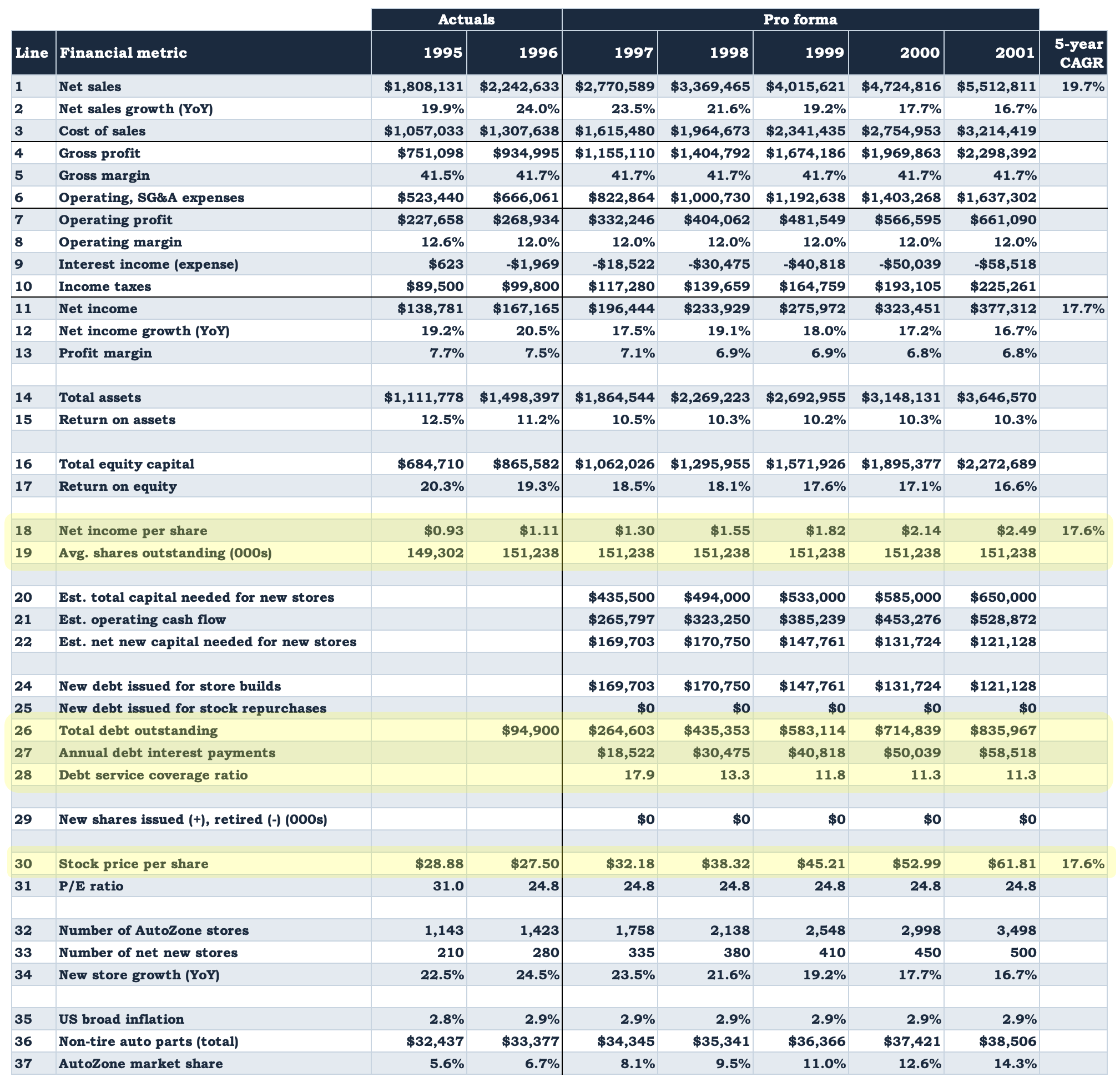
The table above contains a ton of information, but it is relatively straightforward if one walks through it slowly.
Revenue growth. First, the pro forma numbers above assume the revenue growth mentioned above, and as such, should not be taken as gospel. A big part of doing all the competitive analysis earlier in the case study was to get comfortable that good levels of revenue growth could continue in the future. Line 37 provides an estimate for AutoZone’s market share in pro forma 2001, showing it to be 14.3%.
No change in margins. The pro forma numbers assume no changes in the company’s growth and operating margins. One could argue, however, that AutoZone’s increasing scale should improve both gross margins (as its negotiating power gets larger and it is more capable of selling its own branded products) and operating margins (as the company continues to benefit from centralized resources and store operating experience).
Line 34 matches the growth in the number of stores with the growth in revenue assumed. Line 20 shows how much capital would be needed to open that number of stores in any given year (assuming $1.3mn per store), line 21 shows how much could be funded with the operating cash flow of the business, and line 22 shows the remainder that would be needed in the form of new capital.
Debt financing for new stores. Line 24 assumes this capital comes in the form of new debt. I imagine Lampert had a little debate with himself here. From 1991 to 1995, the company issued $150.4mn of common stock, which it used to finance its expansion (after paying off $67.6mn of debt in 1991). By 1996, however, the company was indicating that it would use debt to finance its new store growth, which Lampert must have preferred. I assume the new store expansion shown above is financed with debt at a 7% interest rate, conservatively a bit higher than the 5.67% rate on the company’s $94.4mn debt Revolver.
The company’s net income per share increases by 17.6% per year for the five years through 2001. Its share price also increases by the same amount because I am assuming the P/E does not change.
The pro forma analysis shows very good results for the company and its stock price. And, in order to believe it is possible, building an intimate familiarity with the business and competitive landscape, as we did earlier, is critical. AutoZone had such a different and compelling store offering than either the large competitors or the mom and pop shops that believing its market share could increase from 6% to 14% does not seem like a stretch at all.
Now, as a result of taking on pro forma debt through 2001, the company’s net income growth lags behind its revenue growth. The additional debt service (interest) payments put a greater drag on profit margins. However, since AutoZone’s business was regular, highly recurring, and protected from economic downturns, the company could handle the debt load quite well and, as Lampert knew, had room to take on much more to the benefit of shareholders.
Could AutoZone’s stock do better than slightly lagging the company’s revenue growth?
Here is where things get interesting, and likely a big part of Lampert’s thesis.
Since AutoZone was such a great business with very little debt, it had a lot of runway to take on debt to finance its expansion. But it also had a ton of runway to use debt to buy back shares to better the position of its common stock holders.
As I mentioned earlier, the company issued $150.4mn of common stock from 1991 to 1995, which it used to finance its expansion. Hindsight is 20/20 of course, but it doesn’t take much to see that this share issuance was a mistake on management’s part. One simple way to see that is to compare the IPO price of $5 3/4 per share in April of 1991 to the price of AutoZone’s stock around the time Lampert was looking at it (e.g., $23 3/8 on June 30, 1997). The return achieved by those shares was approximately 26%; it would have been much better for existing shareholders to issue debt at a cost of 6-8%.
When Lampert was analyzing the business and making his first purchases in 1997, he saw this distinctly. He knew that the company’s shareholders could do even better by shifting the capital structure toward more debt (which the company was very capable of bearing) and away from equity.
The table below shows another view of the income statement we saw above, with one difference: the company issues another $225mn of debt each year and uses the proceeds to repurchase shares at the then-outstanding share price.
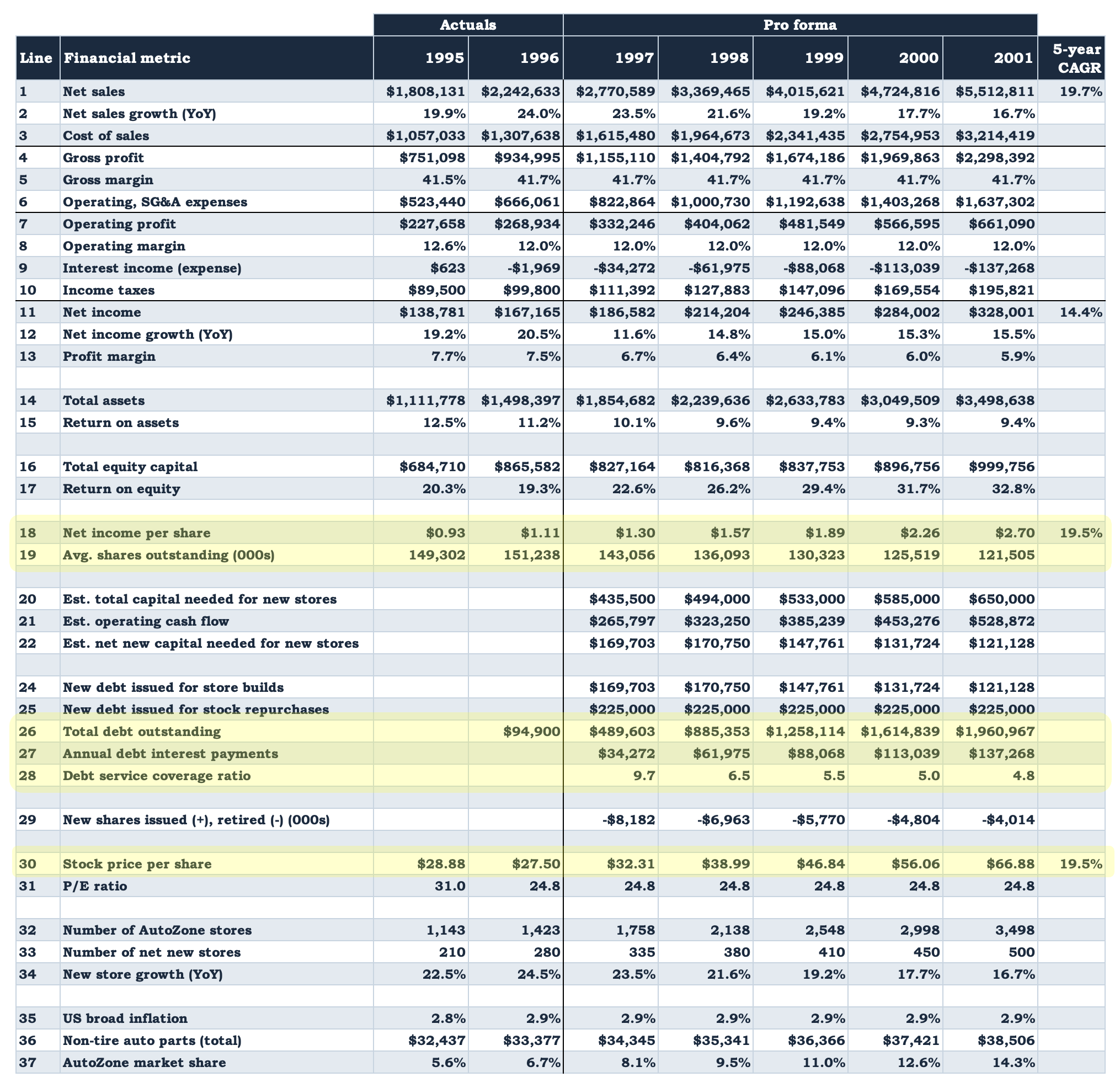
As you can see, the position of equity holders is improved. Line 30 shows the annualized appreciation of AutoZone’s stock price has increased by almost two percentage points to 19.5%. Meanwhile, the company’s debt service coverage ratio is still a comfortable 4.8x.
Now, the benefit of taking on debt to finance stock repurchases is not without risk, of course. And one might rightfully wonder whether taking on almost $2bn in debt is worth it for an extra two percentage points of annualized stock price gain. All in all, I think Lampert saw in AutoZone two things:
First and most importantly, an excellent business at the start of a long runway of taking market share from competitors who were on their heels, and
less importantly, a company that also had enormous financial flexibility and room for balance sheet improvement. AutoZone was not just in a great competitive position, it was also the type of business, by virtue of what it sold, that was buttressed from potential economic downturns. Lampert likely thought he could (and subsequently did) influence the management team to use debt both prudently and aggressively to improve the outcomes for shareholders while still keeping the company in good financial health.
With that pro forma in hand, we can now see how Lampert’s actual investment unfolded against it.
Lampert’s investment results
Lampert is reported to have first invested in AutoZone in 1997,1 although the first public filings of his ownership appear in Q3 1998, after his management vehicles crossed over owning 5% of the company’s common stock. Below, I show a chart of Lampert’s holdings of AutoZone stock, as reported in the SEC’s EDGAR data.
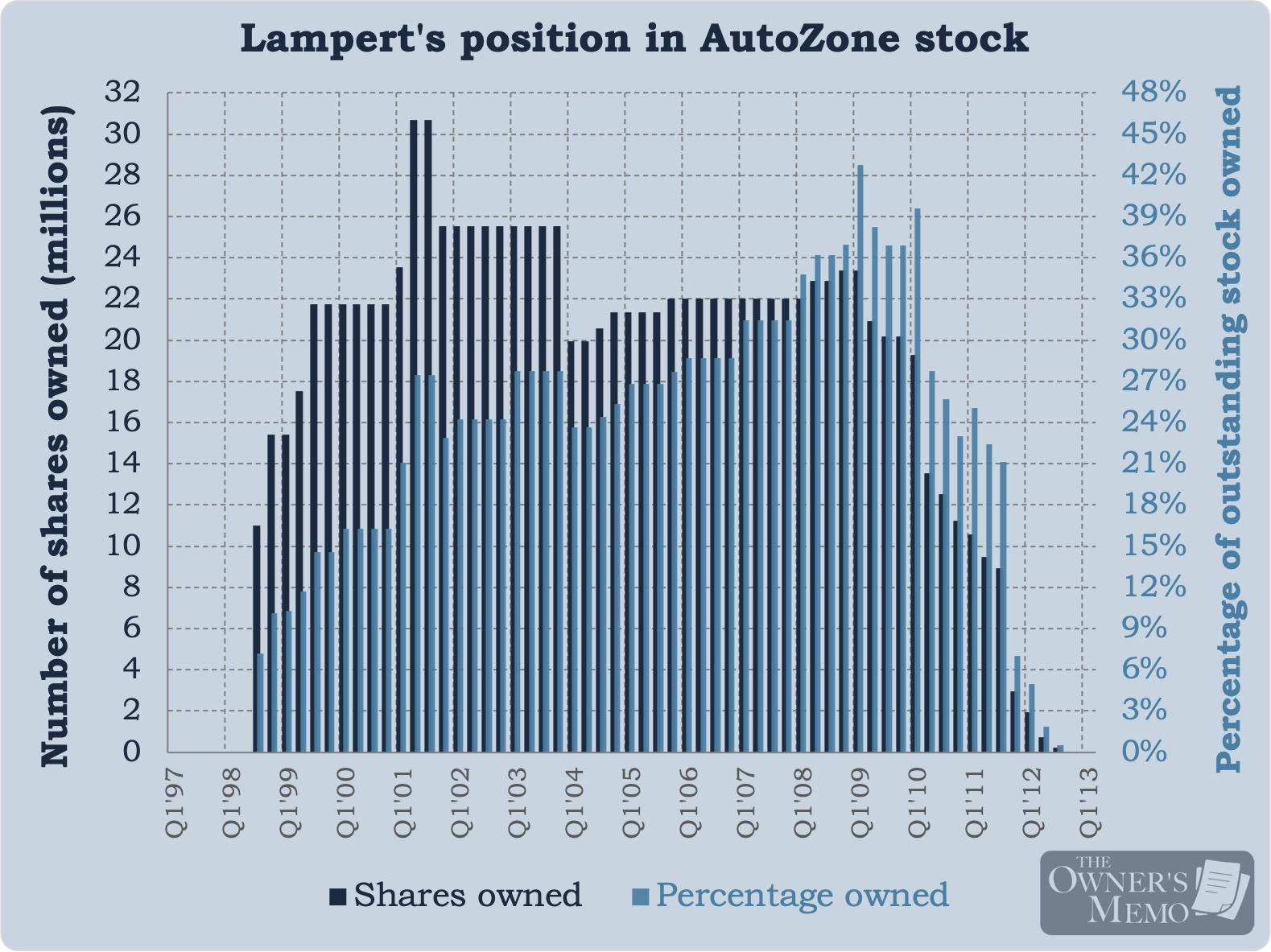
Lampert began buying AutoZone shares in 1997, although I could find no public data for those amounts beyond the simple commentary in the BusinessWeek article mentioned above. He eventually accumulated as much as 30.68 million shares of the company in 2001 before selling down some shares in that year to diversify his holdings and some more in 2003.2
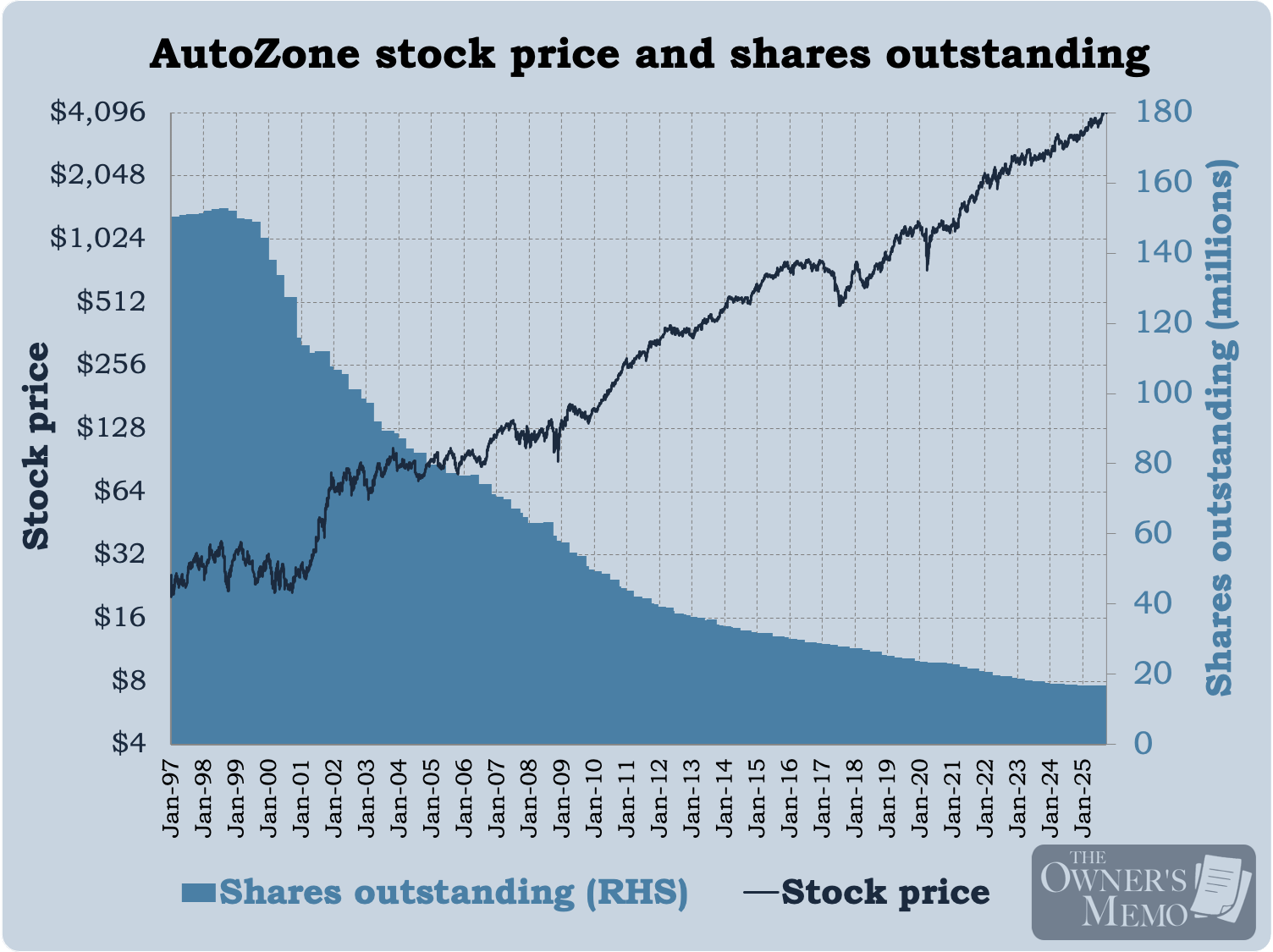
Shortly after Lampert began buying the stock, AutoZone began embarking on a plan for share repurchases, reportedly after Lampert advocated strongly for it. Lampert joined the company’s Board in 1999 and held that position through 2006, after which he handed the position to ESL’s General Counsel, Theodore Ullyot. Because of AutoZone’s aggressive share repurchases, Lampert’s percentage stake in the company continued to rise, eventually reaching 42.7% in Q1 2009. AutoZone’s share count over time is shown below.
Lampert’s estimated return from owning AutoZone for 15 years
Lampert owned AutoZone stock from 1997 through 2012. During that time, AutoZone’s stock price went from $23.39 to $370.60.3 The company’s revenue rose by 3.2x to $8.60bn from $2.69bn, its store count grew to 4,685 from 1,728, and its net income rose by 4.8x to $930mn from $195mn. Its net income per share rose by even more than that, a whopping 18.3x to $23.48 from $1.28. By 2012, the company had only 39.6mn shares outstanding versus 151.0mn in 1997.
Although I don’t know the exact prices he paid for each share of stock, I make some simplifying assumptions, like imagining that he paid the quarterly average price for any purchases made during a given quarter (and similar for any sales). Using such assumptions suggests that Lampert invested roughly $1.2bn in the company’s stock, ultimately grossing $6.8bn from the sale of that stock years later, multiplying his money by 5.7 times. Over the 15 years he owned AutoZone stock, I estimate his annualized internal rate of return to be around 21.3%.4
The stock became a large part of his hedge fund. In his 13F filing from Q4 2007, for example, Lampert reported owning $2.6bn worth of AutoZone stock, 23.3% of his total holdings.
Lampert sold down his stake in AutoZone in the years from 2009 to 2012. The Financial Crisis was unfolding around the start of that time, and Lampert seemed to be increasingly focused on turning around the retailer Sears, an investment that ultimately did not turn out well for Lampert. (Sears was Lampert’s largest holding in that Q4 2007 report, at $6.7bn and 59% of his holdings.)
AutoZone’s continued success
Ultimately, for AutoZone, the success continued. The company has continued expanding and still repurchases its stock to this day, with 16.5mn shares outstanding as of its February 2026 10-Q. From the end of 2012, around the time Lampert sold his last remaining stake in the company, to March 31, 2026, the stock price has increased from $370.60 to $3,377.78, representing an annualized rate of return of 18.1%.
In Poor Charlie’s Almanack, Peter Kaufman presents an investing checklist based on the principles and behavior of Charlie Munger. Entry number seven reads:
“Compound interest is the eighth wonder of the world (Einstein); never interrupt it unnecessarily”
Hindsight is 20/20 of course, but one can’t help but notice that Lampert would be better off today effectively sitting on his hands, sticking with his non-operating position in AutoZone, and not interrupting his great investment in the company.
Summary and takeaways
In the late 1990’s (and even for years after that), AutoZone was starting to expand its store presence and take market share in the auto parts retailing business. The company’s success to date was clearly visible in the company’s 1996 financials and even in financials from years prior. Moreover, the company had very little market share in auto parts retailing, was rapidly expanding to increase it, and seemed to be poised to do so for years to come.
The company provided customers with an excellent product (that is, their retail experience) they couldn’t get elsewhere. In addition, because of the sheer amount of work it took to build out new stores and operate them well, the company seemed to have runway to expand to much higher market share numbers.
When you find a retailer (or any customer offering) that is different, like AutoZone’s, with competitors who are locked into inferior ways of doing business, like the large retailers and small mom and pop shops, the most natural course of events may be for the retailer to take market share for a long period of time. If you are lucky enough to buy it, be very picky about selling it.
With respect to AutoZone, yes, hindsight is 20/20, but one cannot help but be struck by just how compelling the company’s offering was and just how good the business was already doing, even back in 1996. I’m reminded of Charlie Munger describing Berkshire Hathaway’s investment in Coca-Cola in the late 1980’s. He recalled reading Coca-Cola’s financial filings and seeing it “perfectly obvious” that Coke would continue expanding and dominating markets. Reading AutoZone’s financial documents from the 1990’s felt the same way.
If you can find those rare great companies doing everything right, like AutoZone, think hard about whether the price is too high or just seems that way. Business success can continue longer than we often think, especially for cases like AutoZone, where the company spent many years of effort and a lot of money building the best auto parts retailing experience possible for the customer.
“The Next Warren Buffett?”, BusinessWeek, November 22, 2004.
AutoZone 8-K filing dated February 26, 2002. https://www.sec.gov/Archives/edgar/data/866787/000086678702000005/qtwopr.htm
I use 6/30/1997 and 12/31/2012 as the dates for which I calculate prices, and I use AutoZone’s 1997 and 2012 reporting years for company metrics.
The astute reader will notice that multiplying one’s money by 5.7 times over 15 years amounts to only a 12.3% return, if the money was deployed once and the entire investment sold 15 years later. But Lampert’s stock purchases were made over the course of a few years and sold over the course of a few years. The number 15 simply tallies the time from the very first purchase to the very last small sales.
Great article! But I do feel the Sears story is far from over (re: “Lampert’s failure with Sears.) thanks again for this!